
Search
Remove Ads
Advertisement
Search Results

Definition
Oldowan Tools
The appearance of simple stone tools, widely known as Oldowan tools or the Oldowan industry, marked the beginning of our technological revolution. To our knowledge, these artifacts appeared around 2.6 million years ago in the savannahs of...

Definition
Etowah Mounds
Etowah Mounds (also known as Etowah Indian Mounds) is a National Historic Landmark and archaeological site near Cartersville, Georgia, USA, enclosing the ruins of a prehistoric Native American city whose original name is unknown. The present...

Article
Liangzhu Culture Jade
Jade artifacts and icons are almost synonymous with the Chinese culture going back thousands of years. Jade (nephrite) was first worked into recognizable objects c. 6000 BCE during the period of the Houli Culture (c. 6500 - c. 5500 BCE...
Definition
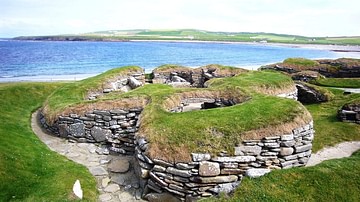
Skara Brae
Skara Brae is a Neolithic Age site, consisting of ten stone structures, near the Bay of Skaill, Orkney, Scotland. Today the village is situated by the shore but when it was inhabited (c.3100-2500 BCE) it would have been further inland. Steady...

Article
Prehistoric Alpine Stilt Houses
Alpine stilt houses are a unique and fascinating aspect of prehistoric architecture in the Alps, which provide valuable insights into the lives and culture of the ancient communities. The houses were built by prehistoric communities living...

Article
The Iraq Museum & Three Wars: Three Steps from Hell
This article documents and elaborates on the many critical behind-the-scenes events, unknown to the public, before the history leaves us. The author The bulk of the “the land between the two rivers” lies in what we call today the Republic...

Interview
Interview: Shung Ye Museum of Formosan Aborigines
Indigenous peoples of Austronesian ancestry are the original inhabitants of Taiwan. Taiwanese indigenous peoples — formerly called Taiwanese aborigines, Formosan people, and Gaoshan (臺灣原住民族) — lived in relative isolation for over 5,000 years...

Definition
Predynastic Period in Egypt
The Predynastic Period in Ancient Egypt is the time before recorded history from the Paleolithic to the Neolithic Age and on to the rise of the First Dynasty and is generally recognized as spanning the era from c. 6000-3150 BCE (though physical...

Definition
Banpo Village
Banpo Village is a Neolithic site in the Yellow River Valley, east of Xi'an, Shaanxi Province, in the People's Republic of China. The site was occupied from c. 4500-3750 BCE and covers almost 20 acres. Over 10,000 stone tools and artifacts...

Definition
Dur-Sharrukin
Dur-Sharrukin (modern Khorsabad, Iraq) was a city built by Sargon II of Assyria (r. 722-705 BCE) as his new capital between 717-706 BCE. The name means Fortress of Sargon and the building project became the king's near obsession as soon as...
