
Search
Remove Ads
Advertisement
Search Results

Definition
Nikephoros II Phokas
Nikephoros II Phokas was Byzantine emperor from 963 to 969 CE. Known as “White Death of the Saracens,” Nikephoros was a fearsome commander who conquered Crete, Cilicia, and much of Syria. While he is known as a great military commander, he...

Definition
Despotate of the Morea
The Despotate of the Morea was a semi-autonomous appanage of the later Byzantine Empire. The Byzantines retook part of the Peloponnese in Southern Greece in 1262 CE, but the Morea was only officially governed by semi-autonomous despots of...
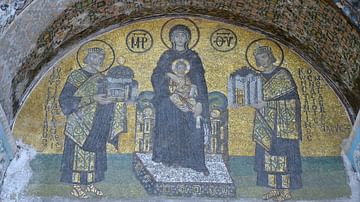
Image
Mosaic with the Virgin Mary, Constantine and Justinian, Hagia Sophia
Mosaic panel located at the southwestern entrance of the basilica Hagia Sophia (Istanbul) depicting the emperor Constantine I holding a model of the city of Constantinople (right), the emperor Justinian I holding a model of Hagia Sophia (left...

Image
Constantine I
The colossal bronze head from a statue of Constantine I, 4th century CE. The head is 1.77 m high. (Capitoline Museums, Rome).

Image
Colossal Bronze Hand of Constantine I
A hand from the colossal bronze statue of Roman emperor Constantine I, 4th century CE. The hand is over 1.5 m in length. (Capitoline Museums, Rome).
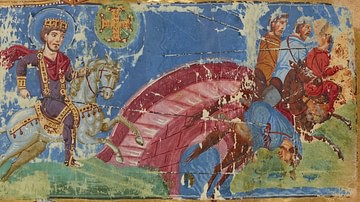
Image
Constantine's Vision
Constantine I's (r. 306-337 CE) vision and the Battle of the Milvian Bridge in a 9th-century Byzantine manuscript. Detail from folio 440 recto of manuscript BnF MS Gr510, dated 879-883 and containing the homilies of Gregory of Nazianzus...

Image
Emperor Constantine
A statue of the Roman Emperor "Constantine the Great" who reigned from approximately 306 to 337 CE.
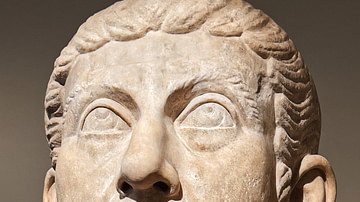
Image
Marble Head of Emperor Constantine I
Marble head of Emperor Constantine I (r. 306-337 CE) by an unknown artist, c. 325-370 CE.
Metropolitan Museum of Art, New York.
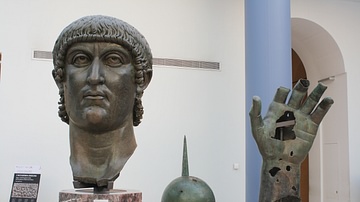
Image
Constantine I Colossus
The head, hand and sphere (symbol of power) from the colossal bronze statue of Constantine I, 4th century CE. The head alone is 1.77 m high. (Capitoline Museums, Rome).
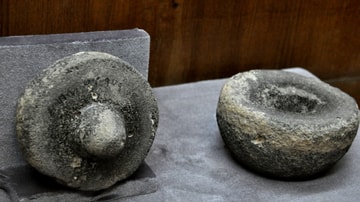
Definition
Mesopotamian Science and Technology - Scientific Method in the Ancient Near East
Mesopotamian science and technology developed during the Uruk period (circa 4000-3100 BCE) and the Early Dynastic period (circa 2900-2350/2334 BCE) of the Sumerian culture of southern Mesopotamia. The foundation of future Mesopotamian advances...
