
Search
Remove Ads
Advertisement
Search Results

Definition
Byzantine Government
The government of the Byzantine Empire was headed and dominated by the emperor, but there were many other important officials who assisted in operating the finances, judiciary, military, and bureaucracy of a huge territory. Without elections...

Image
The Colossus of Constantine
Once located in the west apse of the Basilica of Maxentius, fragments of the Colossus of Constantine are now located in the courtyard of the Palazzo dei Conservatori of the Musei Capitolini on the Capitoline Hill, Rome. Marble, 312 CE.
Image
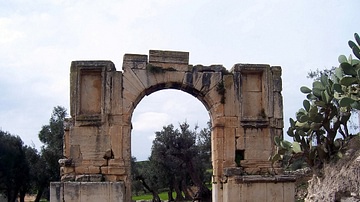
Arch of Alexander Severus, Dougga
The Arch of Alexander Severus is a Roman triumphal arch located in Dougga Tunisia (ancient Thugga). The arch was built in 228 CE, in gratitude to the emperor for his beneficence towards the city. It functioned as one of the city gates, at...
Article
The Hippodrome of Constantinople
The Hippodrome of Constantinople was an arena used for chariot racing throughout the Byzantine period. First built during the reign of Roman emperor Septimius Severus in the early 3rd century CE, the structure was made more grandiose by emperor...

Definition
Byzantine Coinage
The coinage of the Byzantine Empire continued that of its more ancient predecessors and functioned as a convenient method of payment for goods and services, especially to soldiers and officials, and as a means for people to pay their taxes...

Article
Early Christianity
Emerging from a small sect of Judaism in the 1st century CE, early Christianity absorbed many of the shared religious, cultural, and intellectual traditions of the Greco-Roman world. In traditional histories of Western culture, the emergence...

Definition
Nikephoros II Phokas
Nikephoros II Phokas was Byzantine emperor from 963 to 969 CE. Known as “White Death of the Saracens,” Nikephoros was a fearsome commander who conquered Crete, Cilicia, and much of Syria. While he is known as a great military commander, he...

Definition
Despotate of the Morea
The Despotate of the Morea was a semi-autonomous appanage of the later Byzantine Empire. The Byzantines retook part of the Peloponnese in Southern Greece in 1262 CE, but the Morea was only officially governed by semi-autonomous despots of...

Image
Constantine's Conversion
The Emblem of Christ Appearing to Constantine / Constantine's conversion, oil on panel painting by Peter Paul Rubens, 1622.
Philadelphia Museum of Art.
Image
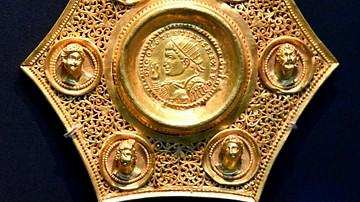
Gold Coin Pendant of Constantine
Gold pendant set with a coin of Constantine the Great, c 320s CE. The British Museum, London. The pendant is made in a pierced metalwork technique popular in fine jewellery of the time. The obverse of the coin depicts a bust of Constantine...
