
Search
Remove Ads
Advertisement
Search Results

Definition
Roman Forum
The Roman Forum or Forum Romanum of ancient Rome was the bustling religious, administrative, legal, and commercial heart of the city from the 7th century BCE onwards. Made increasingly grandiose and ceremonial in function by the Imperial...
Article
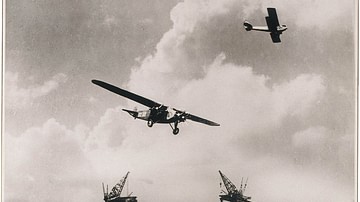
Sydney Harbour Bridge Construction
The Sydney Harbour Bridge – affectionately known as The Coathanger by Australians – was opened to great fanfare and a touch of scandal on 19 March 1932 and was the longest steel arch bridge in the world at the time, with a span of 503 metres...
Article
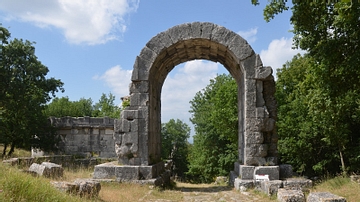
Visitor’s Guide to Carsulae (San Damiano)
Carsulae in Umbria, central Italy, was founded c. 300 BCE and only became a prosperous urban centre after it was connected by the Via Flaminia towards the end of the 3rd century BCE. It was granted the status of municipium and acquired a...

Definition
Byzantine Emperor
The Byzantine Emperor ruled as an absolute monarch in an institution which lasted from the 4th to 15th century CE. Aided by ministers, high-ranking nobility, and key church figures, the emperor (and sometimes empress) was commander-in-chief...

Definition
Roman Empire
The Roman Empire, at its height (c. 117), was the most extensive political and social structure in western civilization. Building upon the foundation laid by the Roman Republic, the empire became the largest and most powerful political and...

Definition
Byzantine Empire
The Byzantine Empire existed from 330 to 1453. It is often called the Eastern Roman Empire or simply Byzantium. The Byzantine capital was founded at Constantinople by Constantine I (r. 306-337). The Byzantine Empire varied in size over the...

Article
Capitals of the Roman Empire: Constantinople & Rome
Constantinople at first had much in common with the temporary capitals of the 2nd and 3rd century CE and the tetrarchic capitals. It was an existing city of medium size, well located on the road network, and unlike most of them, it was also...

Definition
Christianity
Christianity is the world's largest religion, with 2.8 billion adherents. It is categorized as one of the three Abrahamic or monotheistic religions of the Western tradition along with Judaism and Islam. 'Christian' is derived from the Greek...

Image
Map of Constantine the Great and the Transformation of Rome - From Civil War to Christian Empire (306–337 CE)
The rise of Constantine I "the Great" (c. 272–337 CE; reign 306–337 CE) occurred amidst the political instability of the later Roman Empire, following the collapse of Diocletian’s Tetrarchic system. Proclaimed emperor by his troops at Eboracum...
Definition
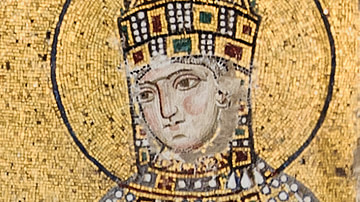
Empress Zoe - The Great Byzantine Ruler
Zoe Porphyrogenita was empress of the Byzantine Empire from 1028 CE until her death in 1050 CE. In an eventful career, she reigned alongside three husbands, had a hand in the succession of her adopted son, and, in 1042 CE, she was co-ruler...
