
Search
Remove Ads
Advertisement
Search Results

Definition
Inca Religion
For the Incas, as with many other ancient cultures, religion was inseparable from politics, history, and society in general. All facets of community life were closely connected to religious beliefs, from marriages to agriculture...

Definition
Parthian Religion
Parthian religion might be best described with two words: inclusive and evolving. As Parthia's empire held within it a variety of cultures, the Parthians wisely left each to their own beliefs and traditions, like the Seleucid...

Definition
Phoenician Religion
The Phoenician Religion, as in many other ancient cultures, was an inseparable part of everyday life. Gods such as Baal, Astarte, and Melqart had temples built in their name, offerings and sacrifices were regularly made to...

Definition
Maya Religion
Maya religious beliefs are formed on the notion that virtually everything in the world contains k'uh, or sacredness. K'uh and k'uhul, similar terms which are used to explain the spirituality of all inanimate and animate things...

Definition
Mesopotamian Religion - Daily Life as a Form of Worship
Mesopotamian religion was central to the people's lives. Humans were created as co-laborers with their gods to hold off the forces of chaos and to keep the world running smoothly. As in ancient Egypt...

Image
Reconstructed Israelite House
Reconstructed Israelite House, 10th-7th cent BCE, Eretz Israel Museum, Tel Aviv, Israel

Image
Israelite Incense Altar
This object is a limestone incense altar. It was excavated from Megiddo and dates to the Iron Age II (9th Century BCE). It has a height of 54.5 cm (21.4 in), a width of 27 cm (10.6 in), and a length of 28.5 cm (11.2 in...

Definition
Urartu Religion
The religion of the Urartu civilization, which flourished principally in ancient Armenia from the 9th to 6th century BCE, was a unique mix of indigenous, Hurrian and Mesopotamian gods and symbolism. The pantheon was headed by...
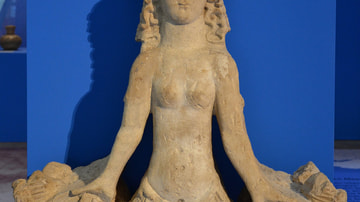
Definition
Scythian Religion
Scythian religion appears to be an amalgam of belief in a pantheon of gods grafted to more ancient animal reverence and shamanistic practice. According to their burial finds, the Scythians appear to have had a deep affinity with...

Image
Judean Pottery
Pottery Dining & Serving Vessels, 9th-6th Century BCE, Arad.
Israel Museum
