
Search
Remove Ads
Advertisement
Search Results

Article
Spiritual Defense - Execration Rituals in Ancient Egypt
Magic was an integral aspect of life in ancient Egypt. The world was created through the power of heka (magic) as Atum stood on the primordial mound of the ben-ben in the middle of the endless waters...

Article
A Ghost Story of Ancient Egypt
The best-known ghost story from ancient Egypt is known, simply, as A Ghost Story but sometimes referenced as Khonsemhab and the Ghost. The story dates from the late New Kingdom of Egypt (c. 1570 - c.1069 BCE) and specifically...
Article
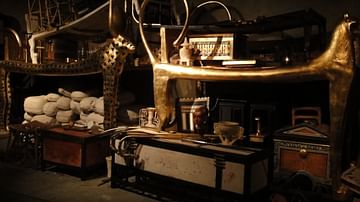
Grave Goods in Ancient Egypt
The concept of the afterlife changed in different eras of Egypt's very long history, but for the most part, it was imagined as a paradise where one lived eternally. To the Egyptians, their country was the most perfect...

Article
Conflict Between the Temple and the Crown in Ancient Egypt
The gods of ancient Egypt were worshipped as the creators and sustainers of all life. People acknowledged their supremacy and intimacy daily through rituals, amulets, and their labor for the king...

Definition
Middle Kingdom of Egypt - Ancient Egypt's Classical Age
The Middle Kingdom (2040-1782 BCE) is considered ancient Egypt's Classical Age, during which it produced some of its greatest works of art and literature. Scholars remain divided on which dynasties...

Article
Police in Ancient Egypt
In any society, members of the community recognize they are required to restrain certain impulses in order to participate in the community. Every civilization has had some form of law which makes clear that the benefits...

Article
The Magical Lullaby of Ancient Egypt
The Magical Lullaby (popularly known as Charm for the Protection of a Child) is an inscription from the 16th or 17th century BCE. The poem exemplifies the ancient Egyptian's personal religious and spiritual practices...
Article
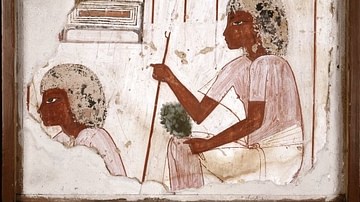
Immortality of Writers in Ancient Egypt
For the ancient Egyptians, life on earth was only one part of an eternal journey which continued after death. One's purpose in life was to live in balance with one's self, family, community, and the gods. Any...

Definition
Second Intermediate Period of Egypt - The Era of the Hyksos
The Second Intermediate Period (circa 1782 to circa 1570 BCE) is the era following the Middle Kingdom of Egypt (2040-1782 BCE) and preceding the New Kingdom (circa 1570-1069 BCE). As with all...

Article
Egyptian Gods - The Complete List
The gods and goddesses of Ancient Egypt were an integral part of the people's everyday lives for over 3,000 years. There were over 2,000 deities in the Egyptian pantheon, many whose names are well known - Isis, Osiris...
