
Search
Search Results
Image
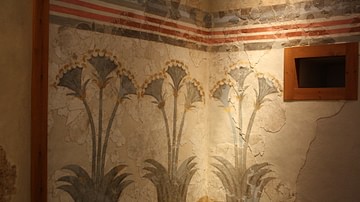
Papyrus Fresco, Akrotiri
The Papyrus Fresco from the Room of the Ladies from the house of the same name, Akrotiri, Thera. Papyrus is not indigineous to Thera and therefore suggests that the Cycladic artists were borrowing iconography from elsewhere, perhaps Egypt...
Image
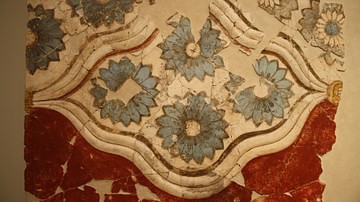
Wall-Painting, Akrotiri
A section of a wall-painting with relief ornament and painted rosettes from Akrotiri on Thera (Santorini), 17th century BCE. (Museum of Prehistoric Thera, Santorini).

Image
Lilies Fresco, Akrotiri
The Lilies Fresco from Akrotiri on the Aegean island of Thera, modern-day Santorini (also known as the Spring Fresco). From Room 2 of Building Delta, c. 17th century BCE. Lilies or papyrus are depicted growing from colourful volcanic rocks...

Interview
Interview: Swallow's Dance by Wendy Orr
In this interview, Ancient History Encyclopedia is speaking with Wendy Orr, the rather prolific author of numerous books who has recently published the book Swallow's Dance. It is a book of historical fiction set in the Bronze Age Aegean...

Definition
Andrea Mantegna
Andrea Mantegna (c. 1431-1506 CE) was an Italian Renaissance artist most famous for his use of foreshortening and other perspective techniques in engravings, paintings, and frescoes. Another common feature of Mantegna's work is his frequent...

Definition
Piero della Francesca
Piero della Francesca (c. 1420-1492 CE) was an Italian Renaissance artist whose paintings and frescoes are characterised by their solid figures, bright colours, and harmonious composition. His masterpieces include the painted panel the Flagellation...
Image
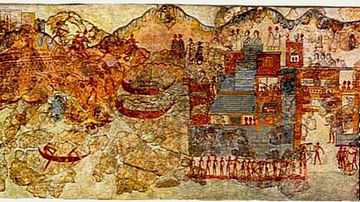
Ship Procession Fresco, Akrotiri
Bronze Age fresco of a ship procession from Akrotiri on the Aegean island of Thera (modern-day Santorini). From Room 5 of the West House, c. 2000-1500 BCE. (National Archaeological Museum, Athens)

Image
House of the Ladies Fresco, Akrotiri
A fresco from the House of the Ladies in Akrotiri on the Aegean island of Thera (Santorini), c. 17th century BCE. The several women depicted on the walls of the room wear typical Minoan dress. Above the women is a representation of a starry...
Image
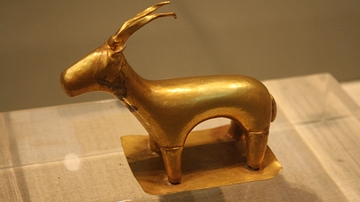
Gold Ibex, Akrotiri
A gold ibex figurine from Akrotiri on Thera (Santorini), 17th century BCE. The figurine was discovered in 1999 CE in mint condition having been originally placed inside a wooden box within a clay chest. It is hollow and was made using the...

Image
Map of Bronze Age Akrotiri
Map of Akrotiri in the Bronze Age, ca. 1600 BC.
