
Search
Search Results

Article
The Minoans & Mycenaeans: Comparison of Two Bronze Age Civilisations
The Bronze Age Aegean in the eastern Mediterranean encompassed several powerful entities: the Minoans on Crete; the Mycenaeans on mainland Greece, and the Cypriots on Cyprus. These cultures are often examined separately, and thus the ample...

Article
Colour & Technique in Renaissance Painting
There were three principal painting techniques during the Renaissance: fresco, tempera, and oils. In all of these techniques, colour was an important part of the painter's armoury, allowing them to create images that would strike a chord...

Article
Herod the Great's Building Program
Herod the Great was the king of Judea from 37-4 BCE. As a client king of Rome, Herod's moniker as "Great" was due more to his grand building program throughout the eastern Mediterranean world. Herod's building program generally ran from 35...
Article
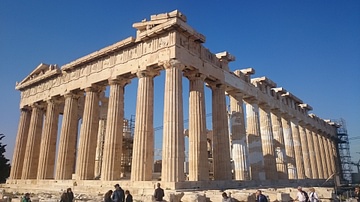
Greek World Heritage Sites
Greece, the 'cradle of western civilization', is home to a large number of spectacular sites from the ancient world, several of which have been placed on the UNESCO World Heritage List. These sites of great historical importance, interest...

Article
Trade in Ancient Greece
Trade was a fundamental aspect of the ancient Greek world and following territorial expansion, an increase in population movements, and innovations in transport, goods could be bought, sold, and exchanged in one part of the Mediterranean...

Article
The Splendours of Roman Algeria
Algeria, Africa's largest country, stretches from the Mediterranean coastline to the Saharan desert interior. The country has some of the finest and most diverse Roman sites, including Timgad and Djémila, both well-preserved and UNESCO-listed...
Article
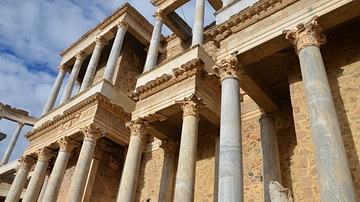
Top 5 Roman Sites in Southern Spain
Almost 700 years of continuous Roman occupation have left impressive traces in the Spanish landscape. Spain was then known as 'Hispania' and is now a fascinating location for the archaeological traveller. The Spanish provinces were amongst...

Interview
Dinner with the Romans: An Interview with Farrell Monaco
The ancient Romans left behind a wealth of remains which help archaeologists and historians to understand what daily life was like in the Roman Empire. From ancient frescos of rich table spreads, to broken wine vessels, carbonized loaves...
Article
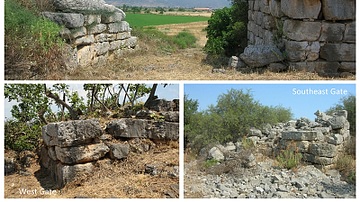
The Island of Gla: A Mycenaean Mystery Solved?
The island of Gla, an enigmatic Mycenaean citadel in the north-eastern corner of the Copais basin lies 70 miles north of Athens, in the region of Boeotia. Lake Copais was the largest lake in Greece until the late-19th century CE when it was...

Interview
Interview with Illustrator Flora of Flaroh Illustration
Join World History Encyclopedia as they chat with Flora of Flaroh Illustration, a freelance illustrator who loves to create art inspired by archaeological artefacts and myths. Kelly (WHE): What is your process in creating art based on history...
