
Search
Remove Ads
Advertisement
Search Results
Image
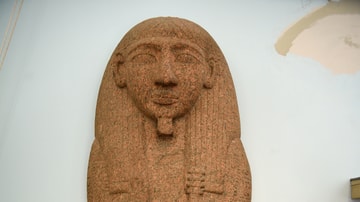
Sarcophagus Lid of Setau
Setau, a viceroy of Nubia for Ramesses II, assumes the pose of Osiris, god of the afterlife. His crossed hands claps a djed (right) and tit (left), symbols of performance and life linked to Osiris and consort Isis. Below...

Image
The Treasury, Petra
The so-called Treasury (Khazneh) in Petra, Jordan. The Treasury's rock-cut, two-storied façade is 24.9 m wide and almost 40 m high and strongly embodies the Hellenistic style and reflects the influence of Alexandria. Both stories...

Video
Osiris: Egyptian God of the Underworld and Judge of the Dead
Osiris was known as the King of the Living and the Eternal Lord since he was the first god born after the universe was created, and then later he was known as the god of the underworld and the...

Video
Hatshepsut: the Forgotten Woman who was a King of Egypt
Hatshepsut, whose name means Foremost of Noble Women or She is First Among Noble Women is the forgotten woman who was a King of Ancient Egypt. She began as regent for her stepson Thutmose III and...

Video
An Introduction to the Faiyum Mummy Portraits
The Faiyum (Fayum) mummy portraits were unearthed by the Egyptologist Flinders Petrie (though others had been found elsewhere earlier) and they were so impressive, expressive and life-like that Flinders...

Collection
Writing in Ancient Egypt
Writing in ancient Egypt developed sometime prior to the Early Dynastic Period (c. 3150-2613 BCE) and came to be recognized as a gift of the god Thoth who empowered humanity through the written word. Writing preserved memory...
Image
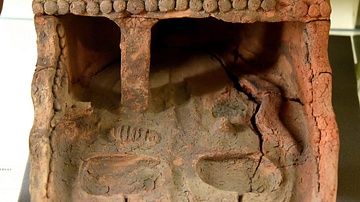
Egyptian Pottery Soul House
Redware pottery depicting the so-called "soul house", from E-Kab, Egypt, 11th to 12th Dynasties, 2024-1700 BCE. It has flattened pellets representing a loop of wood. One of the two pillars which supports the roof is...
Image
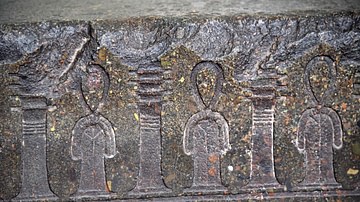
Djed & Tyet
Detail of the upper margin of the sarcophagus of the last native Egyptian pharaoh Nectanebo II showing the so-called "djed" and tyet" symbols. The djed, a pillar-like symbol, represents the backbone (spine) of Osiris, the god of the...

Image
The Treasury of Petra From Above
The so-called Treasury (Khazneh) in Petra, Jordan. The Treasury's rock-cut, two-storied façade is 24.9 m wide and almost 40 m high and strongly embodies the Hellenistic style and reflects the influence of Alexandria...

Video
Comparing Two Ancient Civilisations: Ancient Egypt vs. Mesopotamia
In this video, we are comparing Ancient Egypt vs. Mesopotamia in all sorts of different aspects. We will be looking at the similarities and differences between the geography of the two regions...
