
Search
Remove Ads
Advertisement
Search Results

Definition
Treaty of Paris of 1783
The Treaty of Paris, signed on 3 September 1783 by representatives from Great Britain and the United States, was the peace agreement that formally ended the American Revolutionary War (1775-1783) and recognized the United...
Definition
Adad Nirari I
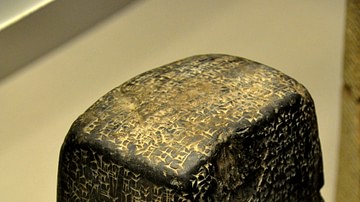
Adad Nirari I (r. 1307-1275 BCE) was the king of the Assyrian Empire who initiated the first major expansion of the Assyrian kingdom from the city of Ashur throughout the region of Mesopotamia. He also instituted what would become...
Definition
Sauska - The Hurrian's Radiant Goddess of Fertility and War
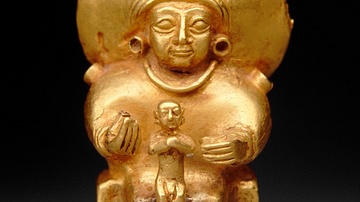
Sauska (also known as Shaushka, Sausga, and Anzili) was the Hurrian-Hittite goddess of fertility, war, and healing. She was worshipped throughout the region known as Hanigalbat (present day Iraq...

Definition
Cynane
Cynane (l. c. 357- 323 BCE, pronounced `Keenahnay') was the daughter of the Illyrian Princess Audata and King Philip II of Macedon, making her the half-sister of Alexander the Great (l.356-323 BCE). Following the Illyrian tradition of...

Definition
New English Canaan
New English Canaan is a three-volume work of history, natural history, satire, and poetry by the lawyer and New England colonist Thomas Morton (l. c. 1579-1647 CE) published in 1637 CE. The book developed out of legal briefs...

Definition
Tutankhamun
Tutankhamun (also known as Tutankhamen and `King Tut', r. c.1336-c.1327 BCE) is the most famous and instantly recognizable Pharaoh in the modern world. His golden sarcophagus is now a symbol almost synonymous with Egypt. His name...

Definition
Viking Art
Art made by Scandinavians during the Viking Age (c. 790-1100 CE) mostly encompassed the decoration of functional objects made of wood, metal, stone, textile and other materials with relief carvings, engravings of animal shapes and...

Definition
Henry V of England
Henry V of England ruled as king from 1413 to 1422. Succeeding his father Henry IV of England (r. 1399-1413), Prince Henry established himself as a fine military leader in battles against English and Welsh rebels in the first...

Definition
Sumer - The Cradle of Civilization
Sumer was the southernmost region of ancient Mesopotamia (modern-day southern Iraq and parts of Kuwait), which has long been considered the cradle of civilization. The name comes from Akkadian, the language of the...
Definition
Orontid Dynasty
The Orontid dynasty (aka Eruandid or Yervanduni) succeeded the Kingdom of Urartu in ancient Armenia and ruled from the 6th to 3rd century BCE. Initially, the Orontids ruled as Persian satraps and the culture, language and political...
