
Search
Remove Ads
Advertisement

 This answer was generated by
 Search Results

Article
The Mesopotamian Pantheon - The Ancient Gods and Goddesses of the Near East
The gods of the Mesopotamian region were not uniform in name, power, provenance or status in the hierarchy. Mesopotamian culture varied from region to region and, because of this, Marduk should not be regarded as King of the Gods in the same...

Definition
Ereshkigal - Mesopotamian Queen of the Dead
Ereshkigal (also known as Irkalla and Allatu) is the Mesopotamian Queen of the Dead, who rules the underworld. Her name translates as "Queen of the Great Below" or "Lady of the Great Place." She was responsible for both keeping the dead within...

Image
Ishtar's Descent into the Underworld Inscription
This large and partially broken clay tablet tells us how Ishtar, goddess of love and war, decided to descend and enter the underworld. During her long journey, she was gradually stripped of her attributes, therefore, she lost all of her...

Image
Goddess Ishtar descent to the underworld tablet
The legend, written in Akkadian, describes how Ishtar, goddess of sexuality and warfare, went to the Underworld. Ishtar decided to undertake the journey, although the Underworld was known as the 'land of no return' for humans and gods alike...
Image
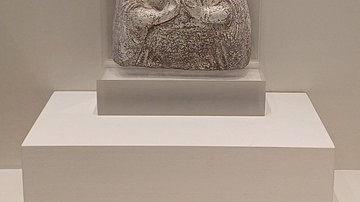
Terracotta Bust of an Underworld Goddess from Pella
Terracotta bust of an underworld goddess from Pella, mid-4th century BCE. Archaeological Museum of Pella, North Macedonia. The ancient city of Pella, the second capital of the ancient Kingdom of Macedonia, was the birthplace of Philip II...

Image
The Passages to the Underworld at Tonina
This building at the Mayan site of Tonina is known as the Passage to the Underworld or the Temple of the Underworld. The archways in this picture lead to an extensive network of hallways which define the word `labyrinth'. As with many structures...

Image
Ra Travelling Through the Underworld
Ra travelling through the underworld in his barque, from the copy of the Book of Gates in the tomb of Ramses I, Egypt, c. 1290 BCE.

Image
Apulian Volute Krater with Scenes of the Underworld (detail)
Apulian red-figure volute krater with scenes of the Underworld, c. 340-330 BCE. Hades sits enthroned in the palace beside a standing Persephone, who holds a four-headed Eleusinian torch. The god wields a bird-tipped staff. (Staatliche Antikensammlungen...
Image
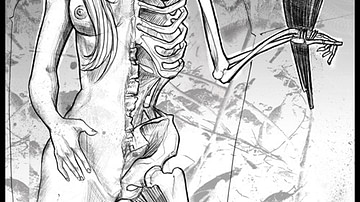
Hel - Norse Queen of the Underworld
Hel, the Norse Queen of the Underworld, as portrayed by the Australia-based artist Tara Ryzebol in 2006. Hel was a female character in Norse mythology who ruled the realm of the dead of the same name. Her kingdom was said to be a gloomy and...
Image
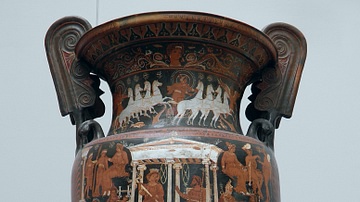
Apulian Krater with Scenes of the Underworld
Apulian red-figure volute krater with scenes of the Underworld, c. 340-330 BCE. Hades sits enthroned in the palace beside a standing Persephone, who holds a four-headed Eleusinian torch. The god wields a bird-tipped staff. (Staatliche Antikensammlungen...
