
Search
Remove Ads
Advertisement
Search Results
Definition
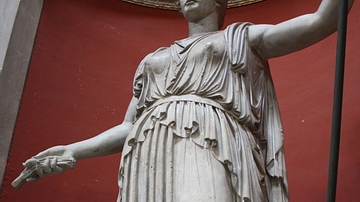
Ceres
Ceres is the goddess of agriculture and the harvest in Roman mythology. Her favor would bring humankind plentiful harvests and fruitful crops, but her wrath brought blight, drought, and famine. Usually depicted as a matron, her symbols included...

Article
Ancient Mesopotamian Beliefs in the Afterlife
Unlike the rich corpus of ancient Egyptian funerary texts, no such “guidebooks” from Mesopotamia detail the afterlife and the soul's fate after death. Instead, ancient Mesopotamian views of the afterlife must be pieced together from a variety...

Article
Burial in Ancient Mesopotamia - Respect for the Living, Honoring the Dead
Burial in ancient Mesopotamia was the practice of interring a corpse in a grave or tomb while observing certain rites, primarily to ensure the passage of the soul of the deceased to the underworld and prevent its return to haunt the living...
Article
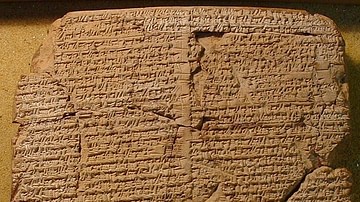
Ancient Mesopotamian Ghost Spell - Keeping the Dead Where They Belong
Medicine in ancient Mesopotamia was based on the belief that illness was caused by supernatural agencies and, although medicines were given and injuries treated, magical spells and incantations were also understood as effective. Among these...

Definition
Inanna - The Most Popular Goddess of Ancient Mesopotamia
Inanna is the ancient Sumerian goddess of love, sensuality, fertility, procreation, and also of war. She later became identified by the Akkadians and Assyrians as the goddess Ishtar, and further with the Hittite Sauska, the Phoenician Astarte...

Definition
Ancient Egyptian Mythology
Egyptian mythology was the belief structure and underlying form of ancient Egyptian culture from at least c. 4000 BCE (as evidenced by burial practices and tomb paintings) to 30 BCE with the death of Cleopatra VII, the last ruler of the Ptolemaic...
Definition
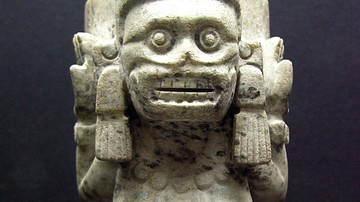
Mictlantecuhtli
Mictlantecuhtli (pron. Mict-lan-te-cuht-li) or 'Lord of the Land of the Dead' was the Aztec god of death. He ruled the underworld (Mictlán) with his wife Mictecacíhuatl. Mictlantecuhtli was worshipped and feared across Mesoamerica. The god...

Article
The Queen of the Night - The Mysterious Burney Relief
The Queen of the Night (also known as the "Burney Relief") is a high-relief terracotta plaque of baked clay, 19.4 inches (49.5 cm) high, 14.5 inches (37 cm) wide, with a thickness of 1.8 inches (4.8 cm), depicting a naked winged woman flanked...

Article
A Visual Who's Who of Greek Mythology
Achilles The hero of the Trojan War, leader of the Myrmidons, slayer of Hector and Greece's greatest warrior, who sadly came unstuck when Paris sent a flying arrow guided by Apollo, which caught him in his only weak spot, his heel. Adonis...

Article
The Death of Gilgamesh
The Death of Gilgamesh is a Sumerian poem relating the death and afterlife of the famous hero-king of Uruk, who had become a legendary figure. The piece is dated to before the Ur III Period (2047-1750 BCE), and although its theme informs...
