
Search
Remove Ads
Advertisement
Search Results

Definition
Ihara Saikaku
Ihara Saikaku (1642-1693) was a Japanese poet and novelist who played a leading role in creating the so-called ‘floating world’ (ukiyo-zoshi) genre of popular literature in the 17th century. His work was significant because, in...

Definition
New Testament
New Testament is the name for the second half of the Christian Bible, compiled from the 2nd century CE, after the separation of Christianity from Judaism. The Christian Bible retained books of the Jewish scriptures, the Old Testament...

Definition
Ancient China
Ancient China produced what has become the oldest extant culture in the world. The name 'China' comes from the Sanskrit Cina (derived from the name of the Chinese Qin Dynasty, pronounced 'Chin') which was translated as 'Cin' by...

Article
Discovering the Glories of Persia
Iran, or Persia as it was formerly known, is a country with a long and rich history stretching back thousands of years and where many civilisations thrived. With 24 historical sites registered on the UNESCO World...
Definition
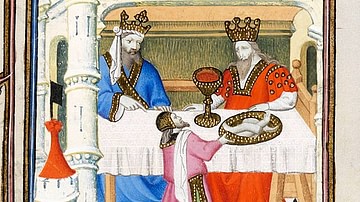
Atreus
Atreus was the mythical Greek king of Mycenae. He is perhaps best known for being the father of Agamemnon and Menelaus, two heroes of the Trojan War, as well as for the terrible curse placed upon his family. This was a hereditary curse...

Definition
Sejong the Great
King Sejong the Great (15 May 1397 to 8 April 1450 CE) ruled Korea from 1418 to 1450 CE as the fourth king of the Joseon Dynasty (also spelled Choson). One of only two Korean kings called 'the Great' today, Sejong had a major...

Definition
Theogony
The Theogony is an 8th-century BCE didactic and instructional poem, credited to the Greek poet Hesiod. The Theogony was, at first, not actually written down, rather, it was part of a rich oral tradition which only achieved written form...

Definition
Greek Alphabet
The Greek Alphabet developed from the Phoenician script at some point around the 8th century BCE. The earlier Mycenaean Linear B script, used primarily for lists and inventories, had been lost during the Greek Dark Age, and the...

Definition
Voltaire
Voltaire (1694-1778) was a French author, historian, and philosopher whose thoughts on religious toleration and moderation of authoritarian power were influential during the Enlightenment. His most famous work today is the satirical...

Definition
Tale of Genji
The 'Tale of the Genji' or Genji Monogatari, written in the 11th century CE by Murasaki Shikibu, a court lady, is Japan's oldest novel and possibly the first novel in world literature. The classic of Japanese literature, the work...
