
Search
Remove Ads
Advertisement
Search Results

Article
European Discovery & Conquest of the Spice Islands
Clove, nutmeg, and mace are native to only a handful of tiny islands in the middle of the vast Indonesian archipelago – cloves on five Maluku Islands (the Moluccas) about 1250 km (778 mi) west of New...

Video
Roman Trade with Africa DOCUMENTARY
We are continuing our new animated historical documentary series on the Roman trade and economy with a video on the trade with Africa. Previously we have covered the Roman trade with India https://www.youtube.com/watch?v=eDTaOOVbxLs...

Definition
Christopher Columbus
Christopher Columbus (l. 1451-1506 CE, also known as Cristoffa Corombo in Ligurian and Cristoforo Colombo in Italian) was a Genoese explorer (identified as Italian) who became famous in his own time as the man who discovered...

Definition
Pirates in the Ancient Mediterranean
Piracy, defined as the act of attacking and robbing a ship or port by sea, had a long history in the ancient Mediterranean stretching from the time of the Egyptian pharaoh Akhenaten (r. 1353-1336 BCE) and throughout...

Definition
Oyo Empire
The Oyo Empire flourished from the 17th to 19th century CE in what is today southwest Nigeria. The Oyo forged an empire thanks to their formidable cavalry units and so came to dominate other Yoruba peoples of the region. The Oyo Empire...

Definition
Bronze Age Collapse - The Decline and Fall of Mediterranean Civilization
The Bronze Age Collapse (also known as Late Bronze Age Collapse) is a modern-day term referring to the decline and fall of major Mediterranean civilizations during the 13th-12th centuries...
Definition
Swahili Coast
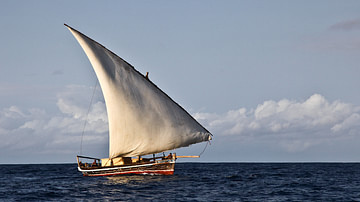
The Swahili Coast on the shores of East Africa was a region where Africans and Arabs mixed to create a unique identity from the 8th century called Swahili Culture. Swahili is the name of their language and means 'people of the coast.'...

Article
Parthia: Rome's Ablest Competitor
As a superpower in its own right and in competition with Rome, Parthia's empire - ruling from 247 BCE to 224 CE - stretched between the Mediterranean in the west to India in the east. Not only did the Parthians win...

Image
The Columbian Exchange - Global Connections and Consequences after 1492
The Columbian Exchange (from 1492 CE) refers to the large-scale transfer of plants, animals, diseases, peoples, and technologies between the Americas and Afro-Eurasia following the transatlantic...

Article
Interrelations of Kerma and Pharaonic Egypt
The vacillating nature of Ancient Egypt's associations with the Kingdom of Kerma may be described as one of expansion and contraction; a virtual tug-of-war between rival cultures. Structural changes in Egypt's...
