
Search
Remove Ads
Advertisement
Search Results

Article
Egyptian Gods - The Complete List
The gods and goddesses of Ancient Egypt were an integral part of the people's everyday lives for over 3,000 years. There were over 2,000 deities in the Egyptian pantheon, many whose names are well known - Isis, Osiris...

Definition
Islam
Islam is an Abrahamic-monotheistic religion based upon the teachings of Prophet Muhammad ibn Abdullah (l. 570-632 CE, after whose name Muslims traditionally add “peace be upon him” or, in writing, PBUH). Alongside Christianity and Judaism...

Definition
Goryeo
Goryeo (Koryo) ruled Korea from 918 to 1392. The kingdom oversaw an unprecedented flourishing in culture and arts with developments in architecture, ceramics, printing, and papermaking. The kingdom was repeatedly invaded by the Mongols...

Definition
Emperor Taizu of Song
Emperor Taizu (960-976 CE), formerly known as Zhao Kuangyin, was the founder of the Song (aka Sung) dynasty which ruled China from 960 to 1279 CE. Taizu settled for a territorially smaller but more unified and prosperous China...

Definition
Ancient Egyptian Mythology
Egyptian mythology was the belief structure and underlying form of ancient Egyptian culture from at least c. 4000 BCE (as evidenced by burial practices and tomb paintings) to 30 BCE with the death of Cleopatra VII, the...

Definition
Shahnameh
The Shahnameh (“Book of Kings”, composed 977-1010 CE) is a medieval epic written by the poet Abolqasem Ferdowsi (l. c. 940-1020 CE) in order to preserve the myths, legends, history, language, and culture of ancient Persia. It is the...

Definition
Emperor Gaozu of Tang
Emperor Gaozu (also Kao-tsu, formerly Li Yuan, r. 618-626 CE) was a Sui military commander who led a rebellion against his former masters, seized control of the state, and founded the Tang Dynasty (618-906 CE). Overshadowed...
Definition
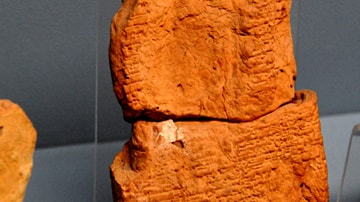
Code of Ur-Nammu - The Oldest Law Code in the World
The Code of Ur-Nammu (circa 2100-2050 BCE) is the oldest extant law code in the world. It was written by the Sumerian king Ur-Nammu (reign circa 2112-2094 BCE) or his son Shulgi of Ur (reign 2094 to...

Definition
Ming Porcelain
The porcelain of the Ming Dynasty of China (1368-1644 CE) benefitted, as did other arts, from the economic success of the 15th century CE, in particular, and the consequent surge in demand for quality handcraft production both...

Definition
Pergamon
Pergamon (also Pergamum) was a major intellectual and cultural center in Mysia (northwest Asia Minor, modern-day Turkey) which flourished under the Attalid Dynasty (281-133 BCE) during the Hellenistic Period. It was the capital of the...
