
Search
Remove Ads
Advertisement
Search Results

Definition
Avesta
The Avesta is the scripture of Zoroastrianism which developed from an oral tradition founded by the prophet Zoroaster (Zarathustra, Zartosht) sometime between c. 1500-1000 BCE. The title is generally accepted as meaning “praise”, though...

Definition
St. Anthony's Fire
St. Anthony's Fire (SAF) is an illness brought on by the ingestion of fungus-contaminated rye grain causing ergot poisoning (ergotism). The disease's common name derives from the medieval Benedictine monks dedicated to that...

Definition
Thomas Aquinas
Saint Thomas Aquinas (l. 1225-1274, also known as the "Ox of Sicily" and the "Angelic Doctor") was a Dominican friar, mystic, theologian, and philosopher, all at once. Although he lived a relatively short life, dying at age 49...

Definition
Peace of Westphalia
The Peace of Westphalia, the name given to the multiple treaties, marked the conclusion of the Thirty Years' War. Signed on 24 October 1648, it aimed to secure political autonomy for the multitude of small states that made...

Definition
Reign of Terror
The Reign of Terror, or simply the Terror (la Terreur), was a climactic period of state-sanctioned violence during the French Revolution (1789-99), which saw the public executions and mass killings of thousands of counter-revolutionary...
Definition
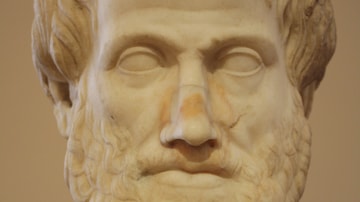
Aristotle
Aristotle of Stagira (l. 384-322 BCE) was a Greek philosopher who pioneered systematic, scientific examination in literally every area of human knowledge and was known, in his time, as "the man who knew everything" and later simply...

Definition
Vishnu
Vishnu is one of the most important gods in the Hindu pantheon. He is considered a member of the holy trinity (trimurti) of Hinduism with Brahma and Shiva. Vishnu is the Preserver and guardian of men, he protects the order of things (dharma...
Definition
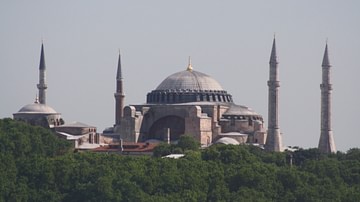
Hagia Sophia
Hagia Sophia in Istanbul, constructed 532-537, continues to be revered as one of the most important structures in the world. Hagia Sophia (Greek Ἁγία Σοφία, for 'Holy Wisdom') was designed to be the major basilica of the Byzantine...

Definition
Maukhari Dynasty
The Maukharis (554 CE - 606 CE) rose as a power after the downfall of the Gupta Empire (3rd to 6th century CE) in the 6th century CE in northern India. The core area of their kingdom was situated in what is now the state of Uttar...

Definition
Pharaoh
The Pharaoh in ancient Egypt was the political and religious leader of the people and held the titles 'Lord of the Two Lands' and 'High Priest of Every Temple'. The word 'pharaoh' is the Greek form of the Egyptian pero or per-a-a, which...
