
Search
Remove Ads
Advertisement
Search Results
Image
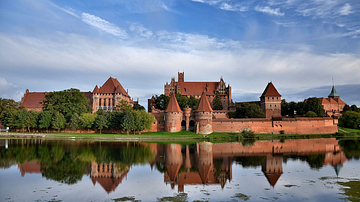
Marienburg (Malbork) Castle
Marienburg Castle, built by the Teutonic Order in Prussia (now part of Poland and called Malbork Castle) in the 13th century CE.

Article
The Layout of a Medieval Abbey
Abbeys were a striking feature of medieval urban and rural landscapes. Their layout and architecture reflected their purpose as cut-off monastic retreats which, conversely, also served and inspired their local communities...

Article
Egyptian Gods - The Complete List
The gods and goddesses of Ancient Egypt were an integral part of the people's everyday lives for over 3,000 years. There were over 2,000 deities in the Egyptian pantheon, many whose names are well known - Isis, Osiris...

Article
Caste System in Ancient India - Varna Ideals in Vedic Times
Ancient India in the Vedic Period (c. 1500-1000 BCE) did not have social stratification based on socio-economic indicators; rather, citizens were classified according to their Varna or castes...

Article
Mesopotamia: The Rise of the Cities - Personal Identity, Safety, and Civilization in the Near East
Once upon a time, in the land known as Sumer, the people built a temple to their god, who had conquered the forces of chaos and brought order to the world. They...

Definition
Pharaoh
The Pharaoh in ancient Egypt was the political and religious leader of the people and held the titles 'Lord of the Two Lands' and 'High Priest of Every Temple'. The word 'pharaoh' is the Greek form of the Egyptian pero or per-a-a, which...

Definition
Philosophy
The word philosophy comes from the Greek philo (love) and sophia (wisdom) and so is literally defined as “the love of wisdom”. More broadly understood, it is the study of the most basic and profound matters of human existence. Philosophical...

Definition
Xerxes I
Xerxes I (l. 519-465, r. 486-465 BCE), also known as Xerxes the Great, was the king of the Persian Achaemenid Empire. His official title was Shahanshah which, though usually translated as `emperor', actually means `king of kings'. He...

Definition
Sennacherib
Sennacherib (r. 705-681 BCE) was the second king of the Sargonid Dynasty of Assyria (founded by his father Sargon II, r. 722-705 BCE). He is one of the most famous Assyrian kings owing to the part he plays in narratives in the biblical...

Definition
Vishnu
Vishnu is one of the most important gods in the Hindu pantheon. He is considered a member of the holy trinity (trimurti) of Hinduism with Brahma and Shiva. Vishnu is the Preserver and guardian of men, he protects the order of things (dharma...
