
Search
Remove Ads
Advertisement
Search Results

Definition
Tutankhamun
Tutankhamun (also known as Tutankhamen and `King Tut', r. c.1336-c.1327 BCE) is the most famous and instantly recognizable Pharaoh in the modern world. His golden sarcophagus is now a symbol almost synonymous with Egypt. His name...

Definition
Zhou Dynasty
The Zhou Dynasty (1046-256 BCE) was among the most culturally significant of the early Chinese dynasties and the longest lasting of any in China's history, divided into two periods: Western Zhou (1046-771 BCE) and Eastern Zhou (771-256...

Definition
Sargonid Dynasty
The Sargonid Dynasty was the last ruling house of the Neo-Assyrian Empire from 722-612 BCE, beginning with the reign of Sargon II and ending with fall of the Neo-Assyrian Empire. Some of the most famous kings in the history of...
Definition
Ganymede
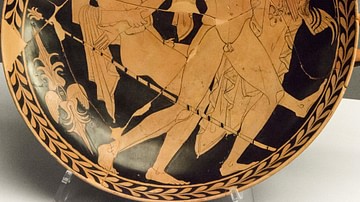
Ganymede (pronounced GAH-nuh-meed) is a youth in Greek mythology who is abducted by Zeus because of his great beauty and brought to Mount Olympus to serve as cupbearer. The story first appears in Homer’s Iliad without any suggestion...

Definition
Wu Zetian
Empress Wu Zetian (Empress Consort Wu, Wu Hou, Wu Mei Niang, Mei-Niang, and Wu Zhao, l. 624-705 CE, r. 690-704 CE) was the only female emperor of Imperial China. She reigned during the Tang Dynasty (618-907 CE) and was one of the most...

Definition
Themis
Themis is the personification and goddess of divine law, will, and justice in Greek mythology. She was held in high esteem by the Olympians, often sitting by Zeus' throne and giving him wise counsel. Themis held the place of Oracle at...

Definition
Kievan Rus
Kievan Rus (862-1242) was a medieval political federation located in modern-day Belarus, Ukraine, and part of Russia (the latter named for the Rus, a Scandinavian people). The name Kievan Rus is a modern-day (19th century) designation...

Definition
The Assassins
The Assassins (aka Nizari Ismailis), were a heretical group of Shiite Muslims who were powerful in Persia and Syria from the 11th century CE until their defeat at the hands of the Mongols in the mid-13th century CE. Secure in their...

Definition
Ancient Persian Mythology
The mythology of ancient Persia originally developed in the region known as Greater Iran (the Caucasus, Central Asia, South Asia, and West Asia). The Persians were initially part of a migratory people who referred to themselves...

Definition
Doctrine of Discovery
The Doctrine of Discovery is a policy enacted initially by the 15th-century Catholic Church proclaiming the right of Christian nations to take possession of the lands of non-Christians in the interest of saving their souls...
