
Search
Remove Ads
Advertisement
Search Results

Definition
Castor and Pollux
Castor and Pollux (the Dioscuri) are figures from Greek and Roman mythology considered the twin sons of Zeus or Jupiter. Semi-divine figures, the twins were credited with the role of saving those in trouble at sea or in grave...
Definition
Chavin Civilization
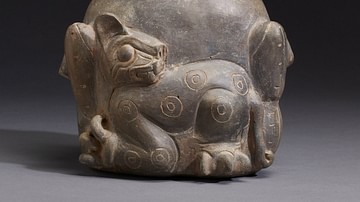
The Chavin civilization flourished between 900 and 200 BCE in the northern and central Andes and was one of the earliest pre-Inca cultures. The Chavin religious centre Chavin de Huantar became an important Andean pilgrimage...

Definition
Kinkakuji
Kinkakuji Temple in Kyoto, Japan, more formally referred to as Rokuon-ji or 'Deer Garden Temple' and otherwise known as 'The Temple of the Golden Pavilion', was first built in 1397 CE. Originally the retirement residence of the shogun...

Definition
Ninna-ji
Ninnia-ji is a Shingon Buddhist temple complex located in Kyoto, Japan. Known as the 'Temple of Heavenly Benevolence', it was founded in 888 CE by Emperor Uda (r. 887-897 CE). Ninna-ji is listed by UNESCO as a World Heritage Site and...

Definition
Thebes (Egypt)
Thebes was the capital of Egypt during the period of the New Kingdom (c.1570-c.1069 BCE) and became an important center of worship of the god Amun (also known as Amon or Amen, a combination of the earlier gods Atum and Ra). Its...
Definition
Kiyomizu-dera
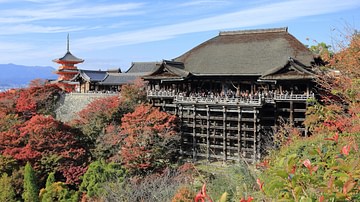
Kiyomizu-dera, otherwise known as the 'Temple of the Pure Water Spring', is a Buddhist temple in Kyoto, Japan. The site is famous for its impressive viewing platform, three-storey Koyasu pagoda and the medicinal pure waters of the...

Definition
Nisaba - Sumerian Goddess of Writing and Scribe of the Gods
Nisaba (also Naga, Se-Naga, Nissaba, Nidaba, and associated with Nanibgal) is the Sumerian goddess of writing, accounts, and scribe of the gods. Although her name is commonly given as Nidaba...

Definition
Xenophon
Xenophon of Athens (l. 430 to c. 354 BCE) was a contemporary of Plato and a fellow student of Socrates. He is best known for his Anabasis (The March Up Country) detailing the retreat of the Ten Thousand Greek mercenaries after the defeat...

Definition
Zeus
Zeus was the king of the 12 Olympian gods and the supreme god in Greek religion. Zeus is often referred to as the Father, as the god of thunder, and the 'cloud-gatherer'. Zeus controlled the weather and offered signs and omens. Zeus generally...

Definition
Odysseus
Odysseus (Roman name: Ulysses) was one of the great pan-Hellenic heroes of Greek mythology. He was famous for his courage, intelligence, and leadership. Odysseus' resourcefulness and oratory skills were instrumental in the Greek victory...
