
Search
Remove Ads
Advertisement
Search Results

Collection
Ancient Egypt: Government & Religion
Government and religion in ancient Egypt were fully integrated beginning with the First Dynasty of Egypt (c. 3150 to c. 2890 BCE). The king was understood as a representative of a god, the specific deity sometimes...
Image
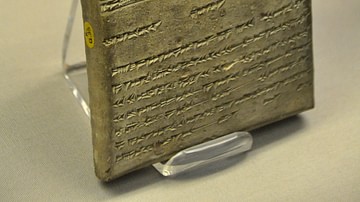
Sumerian Hymn to Ishtar
This hymn to the goddess Ishtar is written in Sumerian; after every line in Sumerian, the text is translated in Akkadian. Such translations have been invaluable to modern scholars. They reflect how the Sumerian language...

Article
Mesopotamian Education - Creating the First Written Works in History
Mesopotamian education was invented by the Sumerians following the creation of writing circa 3600/3500 BCE. The earliest schools were attached to temples, but later schools were established...

Article
Enheduanna - Poet, Priestess, Empire Builder - Redefining the Gods for the People
Enheduanna (circa 2300 BCE) is the world's first author and was the daughter (either literally or figuratively) of the great empire-builder Sargon of Akkad (reign 2334-2279 BCE...

Definition
Tiamat - The Great Mesopotamian Goddess of Chaos
Tiamat is the Mesopotamian goddess associated with primordial chaos and the salt sea, best known from the Babylonian epic Enuma Elish. In all versions of the myth, following the original, Tiamat always...

Definition
Mesopotamia - The Beginning of Beginnings
Mesopotamia (from the Greek, meaning "between two rivers") was an ancient region located in the Near East (Middle East) bounded in the northeast by the Zagros Mountains and in the southeast by the Arabian Plateau...
Definition
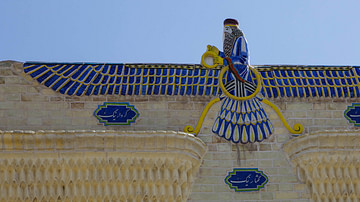
Zarathustra
Zarathustra (also given as Zoroaster, Zartosht, Zarathustra Spitama, l. c. 1500-1000 BCE) was the Persian priest-turned-prophet who founded the religion of Zoroastrianism (also given as Mazdayasna “devotion to Mazda”), the first monotheistic...

Definition
Code of Ur-Nammu - The Oldest Law Code in the World
The Code of Ur-Nammu (circa 2100-2050 BCE) is the oldest extant law code in the world. It was written by the Sumerian king Ur-Nammu (reign circa 2112-2094 BCE) or his son Shulgi of Ur (reign 2094 to...

Definition
Ishtar
Ishtar (Inanna in Sumerian sources) is a primary Mesopotamian goddess closely associated with love and war. This powerful Mesopotamian goddess is the first known deity for which we have written evidence. While largely unknown in the modern...

Article
Scribes in Ancient Mesopotamia - The Beginning of History
Scribes in ancient Mesopotamia were highly educated individuals trained in writing and reading on diverse subjects. Initially, their purpose was to record financial transactions through trade, but...
