
Search
Did you mean: Armenian Mythology?
Remove Ads
Advertisement
Search Results

Definition
Sphinx
A sphinx is a mythical creature with the body of a lion, most often with a human head and sometimes with wings. The creature was an Egyptian invention and had a male head - human or animal; however, in Greek mythology, the creature had...
Definition
Thanatos
Thanatos is the personification of Death in Greek mythology. He is the son of Nyx (Night) and the twin brother of Hypnos (Sleep). Some sources also name Erebus (Darkness) as his father. As the personification of Death, Thanatos works...

Definition
Aeneas
In Greco-Roman mythology, Aeneas is a Trojan prince and the legendary founder of the Romans. He is the son of Anchises, a member of the Trojan royal family, and the goddess Aphrodite/Venus. Aeneas was one of the few Trojan heroes who...

Definition
Castor and Pollux
Castor and Pollux (the Dioscuri) are figures from Greek and Roman mythology considered the twin sons of Zeus or Jupiter. Semi-divine figures, the twins were credited with the role of saving those in trouble at sea or in grave...

Definition
Hercules
Hercules (Herakles) was a hero of Greek mythology famous for his great strength and endurance. Celebrated as an extraordinary mortal, his success in seemingly impossible labours won him an immortal place amongst the gods. As the greatest...

Definition
Ares
Ares was the Greek god of war. He was perhaps the most unpopular of all the Olympian gods because of his quick temper, aggressiveness, and unquenchable thirst for conflict. Ares famously seduced Aphrodite, unsuccessfully fought with Hercules...

Definition
Aphrodite
Aphrodite was the ancient Greek goddess of love, beauty, desire, and all aspects of sexuality. She could entice both gods and men into illicit affairs with her beauty and whispered sweet nothings. Aphrodite was born near Cyprus from...

Definition
Zeus
Zeus was the king of the 12 Olympian gods and the supreme god in Greek religion. Zeus is often referred to as the Father, as the god of thunder, and the 'cloud-gatherer'. Zeus controlled the weather and offered signs and omens. Zeus generally...
Image
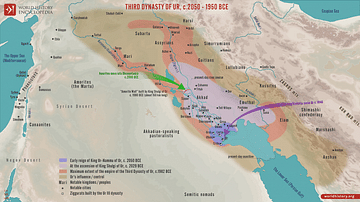
Map of the Third Dynasty of Ur - Sumerian Temples, Tablets, and the Birth of Legal Tradition in Ancient Mesopotamia
This map illustrates the rise of the Sumerian city-state of Ur following the collapse of the Akkadian Empire (reign: circa 2334 - 2154 BCE). In the...

Video
Crash Course World Mythology Preview
Crash Course Mythology with Mike Rugnetta is here, and we have the preview video to prove it. We'll be uploading Friday afternoons to fulfill all your hunger for foundational cultural stories and whatnot. Want...
