
Search
Did you mean: Armenian Mythology?
Remove Ads
Advertisement
Search Results

Definition
Baldr
Baldr is a god in Norse mythology associated with light, wisdom, and courage, although he is never specifically defined as the god of any of these. He is best known for his dramatic death, which heralds the coming of Ragnarök, the end...
Definition
Eileithyia
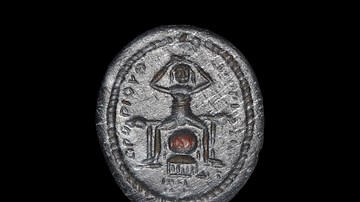
Eileithyia (or Ilithyia) was the goddess of childbirth in Greek mythology, with the power to either help or hinder childbirth. She most famously played a role in the birth of Hercules and Apollo. Eileithyia was the daughter of Zeus...

Definition
Vulcan
Vulcan or Volcanus was the Roman god of fire and forge, the equivalent of Hephaestus from Greek mythology. The son of Jupiter and Juno, he was the special patron of blacksmiths and artisans. As the god of the forge and the devastating...

Definition
Helen of Troy
Helen of Troy (sometimes called Helen of Sparta) is a figure from Greek mythology whose elopement with (or abduction by) the Trojan prince Paris sparked off the Trojan War. Helen was the wife of Menelaus, the king of Sparta, and...

Definition
Qilin (Chinese Unicorn)
The qilin (麒麟, or simply lin 麟) is a Chinese mythical creature, frequently translated as "Chinese unicorn." While this term may suggest a one-horned creature, the qilin is often depicted with two horns. However, like the...
Definition
Perseus
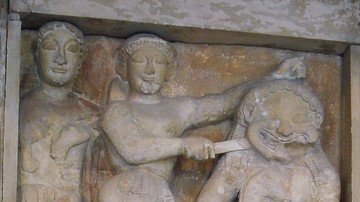
Perseus is one of the greatest and oldest pan-Hellenic heroes of Greek mythology. Perseus famously killed the dreaded Medusa, a Gorgon with snakes as hair and whose stare turned men to stone. Perseus also carried out the daring rescue...

Definition
Neptune
Neptune is the Roman god of the sea and the Roman equivalent of the Greek god Poseidon. He was originally a god of fresh water and became associated with Poseidon early on in Roman history. He lives in a golden palace at the bottom of...

Definition
Horae
The Horae (Horai, sing. Hora) were the personification and goddesses of the seasons and the hours and, later on, were regarded as goddesses of order and justice in Greek mythology. They were the daughters of Zeus and the Titaness Themis...
Definition
Giants
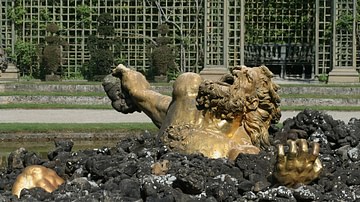
In Greek mythology, the Giants (Gigantes) are an aggressive race of creatures who were born from Gaia (the Earth) after drops of Uranus' blood fell on the Earth after he was castrated. The Giants had great strength and were fearsome to...

Definition
Ull
Ull (also known as Ullr), with his bow and skis, is such an elusive presence in Norse mythology that no conclusive remarks can be made about him. The 13th-century Icelandic author Snorri describes him only briefly in his Prose Edda, and...
