
Search
Did you mean: Temple?
Remove Ads
Advertisement
Search Results
Image
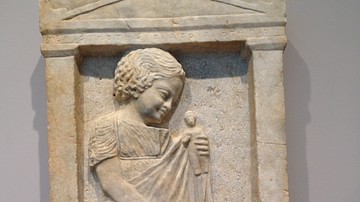
Grave Stele of a Young Girl, Melisto
Stele showing a girl holding a doll in one hand and a bird in the other, which she seems to be offering with a gentle smile to the small dog jumping up to greet her, c. 340 BCE.
Harvard Art Museums.

Image
Buddhist Stele, Unified Silla Kingdom
A soapstone Buddhist stele from the Unified Silla Kingdom of Korea. From the Piamsa Temple. The scene depicts Buddha and disciples with apsaras looking on. Height: 40 cm, c. 673 CE. (National Museum of Korea...
Image
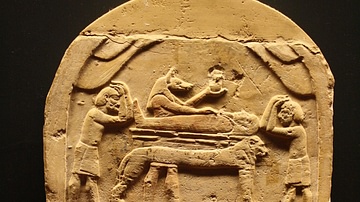
Egyptian Funerary Stele
An Egyptian funerary stele of Ankh Hapy with an aramaic inscription. Limestone, from Memphis, 27th Dynasty, 525-404 BCE. (Vatican Museums, Rome)
Image
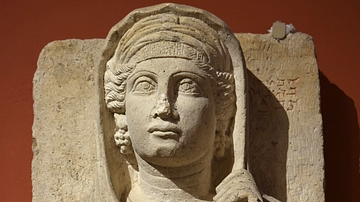
Palmyra Grave Stele
A sandstone grave stelw from Palmyra, Syria. Known as the grave stele of Abkha, daughter of Akhou. 2nd century CE. (Pushkin Museum, Moscow)
Image
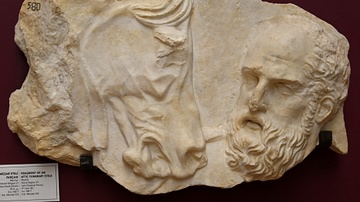
Attic Funerary Stele
Only this fragment of a large funerary stele has survived. It shows an old bearded man, who has frontal baldness, facing a horse head. Marble. Late Classical Period, 4th century BCE. probably from Attica Region, in modern-day...
Image
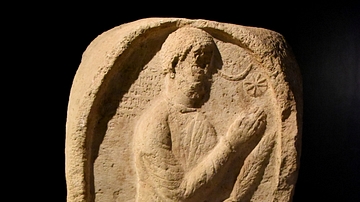
Parthian Stele from Ashur
The Aramaic inscription says that this stele was erected in the 324th year of the Seleucid calendar (12-13 CE) by Sanashu's son, Re'n-tayar, the esteemed shepherd, for the goddess Sherua. Parthian, first century CE. From...
Image
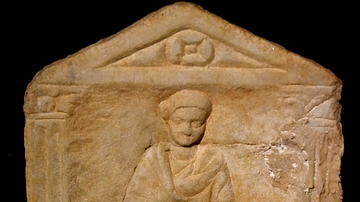
Funerary Stele from Aleppo
This is a marble funerary stele. The Greek inscription reads: "Here lies the baby, Germanicus Andros, who has a spirit. He left the troubles of wisdom and effort to his mother and father." From Aleppo, in modern-day...

Image
Sargon II Basalt Stele
This embossed human head stele is believed to be Sargon II (reigned 722-705 BCE) "who was one of the most important kings of the Neo-Assyrian Empire as founder of the Sargonid Dynasty." He is the father of Sennacherib (reigned...
Image
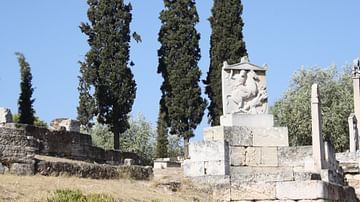
Dexileos Stele
Dexileos Stele replica in situ, Dipylon Cemetery, Athens. (Original in the Kerameikos Museum, P 1130, c. 394 BCE)
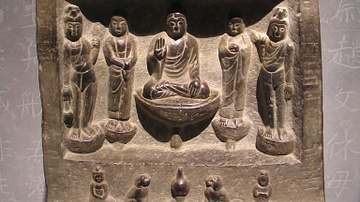
Image
Balhae Stele Depicting Buddha
A stele from the Balhae kingdom depicting a seated Buddha. 698-926 CE. (National Museum of Korea, Seoul, South Korea)
