
Search
Did you mean: Temple?
Remove Ads
Advertisement
Search Results
Image
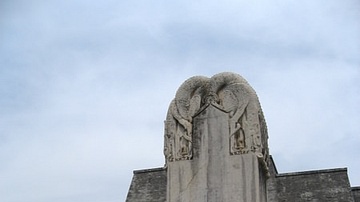
Wu Zetian's Stele
Wu Zetian's (r. 683-704 CE) Stele at Quianling Mausoleum where she was buried along with her husband Gaozong.
Image
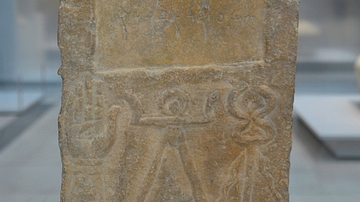
Punic Stele with Goddess Tanit
Punic stele with a crescent moon and the sign of the Phoenician goddess of fertility Tanit, found in Cirta (ancient Constantine, Algeria), around 300-200 BCE. Now in Louvre Lens, France.

Image
Greek Warriors Stele
A marble stele depicting two Greek warriors. Taman Peninsula, 4th century BCE. (Pushkin Museum, Moscow)
Image
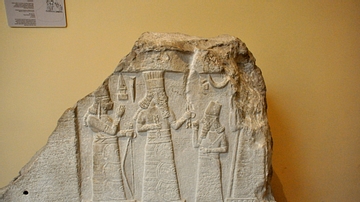
Shamsh-res-usur Stele
Shamsh-res-usur was a local governor of Mari and Suhi. The stele tells us that this governor reigned for 13 years. During this period, he re-built the city of Gabarri-Ibni, established irrigation canals, and encouraged the...
Image
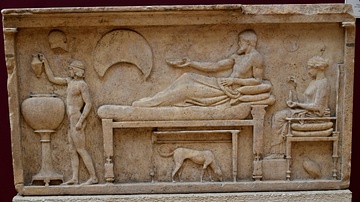
Funerary Stele Showing a Banquet Scene from Thasos
This marble funerary stela depicts a banquet scene. The deceased is shown at the center of the stele. He reclining on a couch. His right arm is raised, expecting a wine cup, which is being filled by...
Image
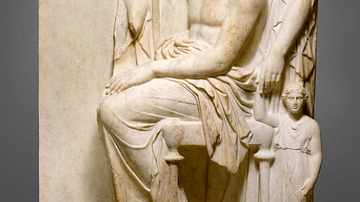
Marble Grave Stele with a Family Group
This marble grave stele depicting a family group (from Attica, Greece) is dated to c. 360 BCE. It is now housed at The Metropolitan Museum of Art.
Image
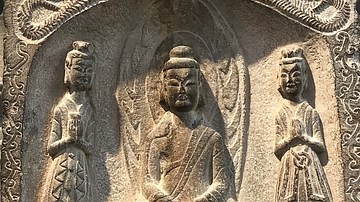
Chinese Buddhist Votive Stele
This Buddhist votive stele made from chalkstone comes from China's Shanxi province, and it dates from c. 520 CE during the era of the Northern Wei Dynasty. (Museum Rietberg, Zürich)
Image
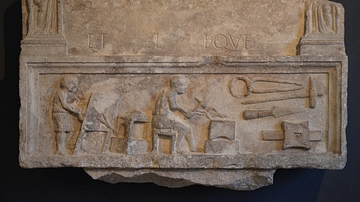
Funerary Stele of a Blacksmith
Limestone funerary stele of a blacksmith. The relief shows the inside of the blacksmith's workshop with forge tools and workshop products. An assistant is rekindling the fire in the forge using bellows. He is standing...
Image
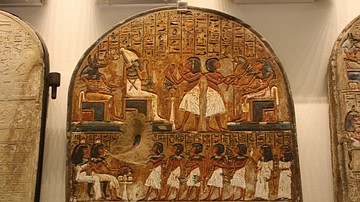
Minhotep & Nakhtmin Relief Stele
A sandstone relief stele depicting in the top panel Minhotep and his son Nakhtmin making offerings to Hathor, Anubis, and Osiris. The middle panel shows Minhotep and his wife Nefertari. The bottom panel shows Nakhtmin...
Image
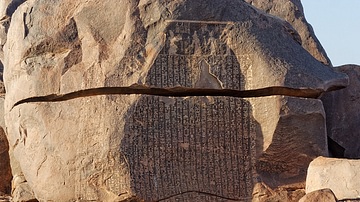
Famine Stele
The Famine Stele is an inscription from the Ptolemaic Dynasty of Egypt (332-30 BCE), which tells the story of how King Djoser saved his country.
