
Search
Did you mean: Temple?
Remove Ads
Advertisement
Search Results

Image
Stele of Minnakht, Chief of the Scribes
Stele of Minnakht, chief of the scribes, 14th century BCE. (Louvre Museum, Paris)

Image
Stele of the Akkadian king Naram-Sin
According to the inscription on the diorite piece of stele, it belongs to King Naram-Sin. It was found in Pir Hüseyin, a village near Diyarbakır. As it shows the borders of the Akkadian State in the era of Naram-Sin...

Image
Stele of King Nabonidus
It narrates the various religious activities of king Nabonidus and contains the harassment of enemies to the city of Babylon and nearby cities and the renovation of these cities by him as well as homage paid to Gods welling...
Image
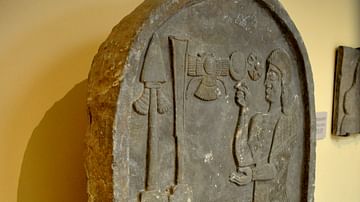
Stele of Bel-harran-beli-usur
Bel-harran-beli-usur was a high palace official (chamberlain) during the reign of the Assyrian kings Shalmaneser IV (782-773 BC) and Tigleth-Pileser III (744-727 BC). He built a city and a large temple to the west of...
Image
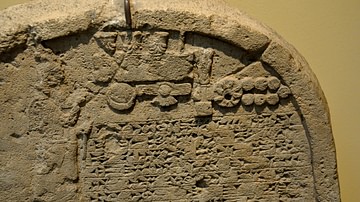
Stele of King Sennacherib, a Close-up View
Limestone stele depicting Sennacherib praying in front of divine symbols and gods and recording the king's achievements and expansion of his royal capital, Nineveh. From Nineveh, Mesopotamia, modern-day northern...
Image
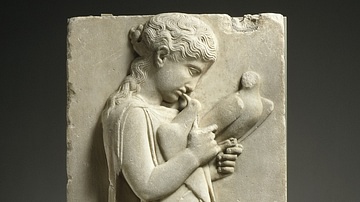
Stele of Little Girl with Doves
A marble stele depicting a young girl saying farewell to her pet doves as she gently holds them. Doves were popular animals in ancient Greece and frequently appeared in mythology and literature. Greek, Parian marble...
Image
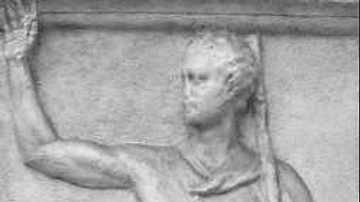
Stele of Polybius
Cast of a stele depicting the 2nd century BCE Greek historian Polybius.
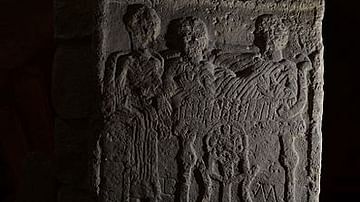
Image
Stele with Epitaph from Roman Dacia (Romania)
A Roman stele with an epitaph from the ancient town of Potaissa in Dacia (present-day Turda, Romania). It was made between c.151-270 CE. Height: 205 cm (80.7 in) Width: 77 cm (30.3 in) Depth: 17 cm...
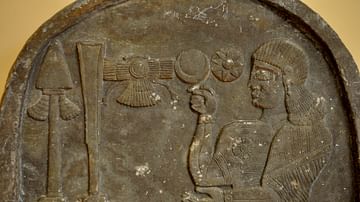
Image
Stele of Bel-harran-beli-usur, close-up
Bel-harran-beli-usur was a high palace official (chamberlain) during the reign of the Assyrian kings Shalmaneser IV (782-773 BC) and Tigleth-Pileser III (744-727 BC). He built a city and a large temple to the...
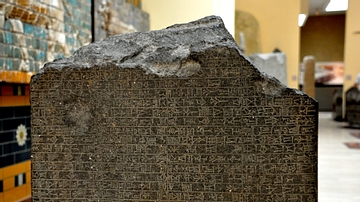
Image
Stele of King Nabonidus, a close-up view
It narrates the various religious activities of king Nabonidus and contains the harassment of enemies to the city of Babylon and nearby cities and the renovation of these cities by him as well as homage paid...
