
Search
Did you mean: Temple?
Remove Ads
Advertisement
Search Results

Image
Thebes Funerary Stele
A funerary stele from Thebes, Egypt. Plastered and painted wood. 7th-4th century BCE. (Archaeological Museum of Milan, Italy)
Image
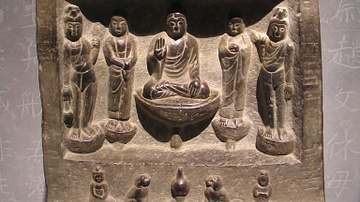
Balhae Stele Depicting Buddha
A stele from the Balhae kingdom depicting a seated Buddha. 698-926 CE. (National Museum of Korea, Seoul, South Korea)

Image
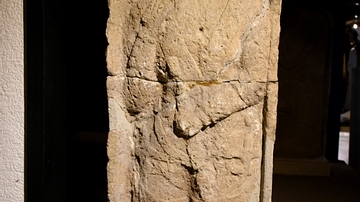
Neo-Assyrian Political Pact Stele, Al-Anbar
Only this fragment of a large stele has survived. On the surface, the Assyrian and Babylonian kings were carved in relief. The cuneiform inscription narrates a political treaty between them. The faces of...
Image
Parthian Sandstone Stele from Ashur
The man depicted on the stele was represented frontally. He raises his right arm while his left hand holds what appears to be a staff. A sword hangs down at his left waist. The divine emblems of Ishtar and Sin...

Image
Egyptian Funeral Stele
Plastered and painted funerary stele from the 7th-4th century BCE.
Egyptian Museum, Castello Sforzesco, Milan.
Image
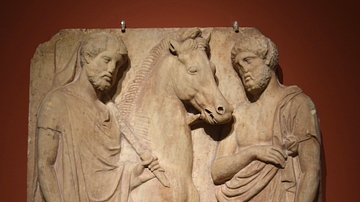
Athenian Horseman Grave Stele
The marble grave stele of an Athenian horseman. Attica, 370s BCE. (Pushkin Museum, Moscow)
Image
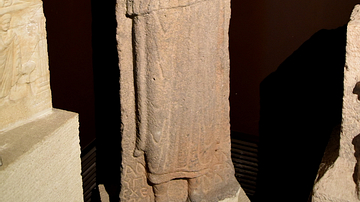
Funerary Stele of Errethas and Marthes
The inscription on this basalt funerary stele mentions the names of Errethas and Marthes. Roman Period, January 109 CE. From Damascus, in modern-day Syria. (Museum of Archaeology, Istanbul, Turkey).
Image
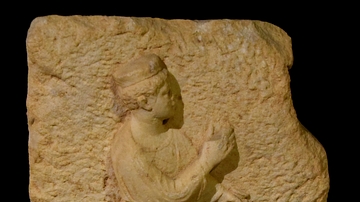
Votive Stele from Sidon
This is a marble votive stele depicting a standing male looking to the right. He holds objects in both hands and wears a head cap. Roman Period, 5th to 4th century BCE. From Sidon, in modern-day Lebanon. (Museum of Archaeology...
Image
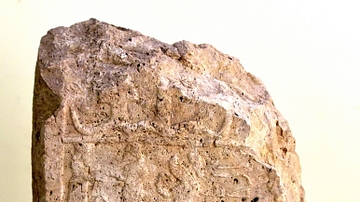
Assyrian Stele from Anat
This stele depicts three horizontal registers. The upper register depicts a snake and some symbols. The middle register depicts two standing male figures on the left and a rampant winged human-headed sphinx before some...
Image
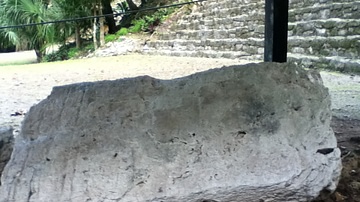
Maya Stele in Grand Plaza Chacchoben, Mexico
Weathered and broken stele in the Grand Plaza of the Maya city of Chacchoben, Mexico, c. 700 CE. It rests at the foot of the stairs leading up to the Gran Basamento plateau where religious rituals were held...
