
Search
Did you mean: Nile?

 This answer was generated by
 Search Results
![Moabite Stone [Mesha Stele]](https://www.worldhistory.org/img/c/p/360x202/10037.jpg?v=1747932305)
Definition
Moabite Stone [Mesha Stele]
The Moabite Stone, otherwise known as the Mesha Stele, contains an ancient inscription by Mesha, King of Moab during the late 9th century BCE, elements of which match events in the Hebrew Bible. The inscription describes two aspects of how...
Article
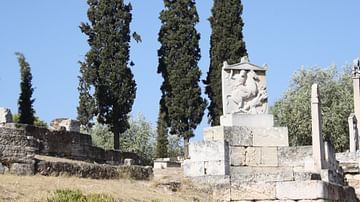
The Dexileos Stele: A Study of Aristocracy and Democracy in Greek Art
The Dexileos Stele assesses the way that Athenian political thought penetrated all levels of society, showing the conflict that the aristocratic classes were faced with in trying to find their place within the Athenian Democracy. As a visual...

Article
The Banquet Stele of Ashurnasirpal II
When he came to the throne in 884 BCE, Ashurnasirpal II had to attend to revolts which broke out across the empire. He ruthlessly put down all rebellions, destroyed the rebel cities and, as a warning to others, impaled, burned, and flayed...
Image
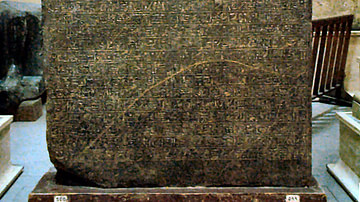
Stele of Merenptah
Stele of Merenptah. Israel as a cultural entity is first mentioned in this stele of the Egyptian pharaoh Merenptah (1213-1203 BCE) in which he states that “Israel lies devastated, bereft of its seed”. (Cairo Museum, Egypt)
Image
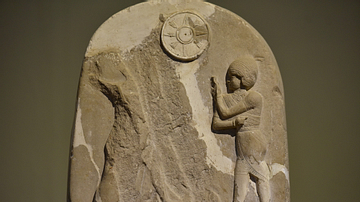
Stele of Dadusha at the Iraq Museum (detail)
This detail shows the upper register of the stele of Dadusha. The stele is an elongated stone monument which originally stood at the Temple of Adad at Eshnunna. The front side is carved with four registers while the narrow sides were inscribed...
Image
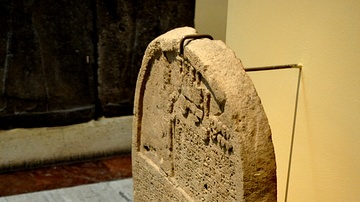
Stele of King Sennacherib
This stele was made of limestone and was found in Nineveh. On the relief, the Assyrian king Sennacherib prays in front of divine symbols and Gods. It records the king's achievements and expansion of his royal capital, Nineveh. Reign of Sennacherib...
Image
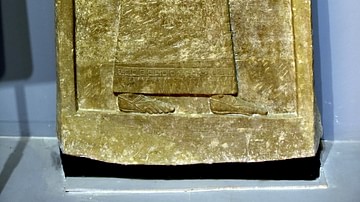
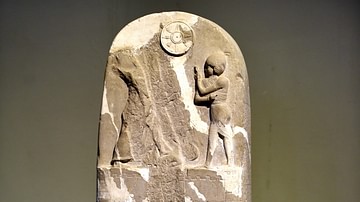
Stele of Adad-Nirari III
Limestone stele of the Assyrian king Adad-Nirari III (r. 810-783 BCE) from Tell al-Rimah, in modern-day Nineveh Governorate, Iraq. The king is praying before gods and goddesses symbols. The cuneiform inscriptions mention the king's titles...

Image
Stele of Pay
The limestone 'Stele of the Scribe Pay'. On the left the gods Osiris, Isis and Horus watch various funerary ceremonies involving the deceased. New Kingdom, Dynasty XIX, 1292-1186 BCE, provenance unknown. (Egyptian Museum, Turin)
Image
Stele of Dadusha, King of Eshnunna
The stele is an elongated stone monument which originally stood at the Temple of Adad at Eshnunna. The front side is carved with four registers while the narrow sides were inscribed with 220 lines of a cuneiform text divided into 17 columns...
Image
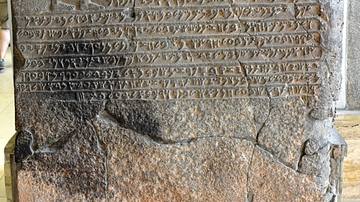
Stele of Prince Kilamuwa from Sam'al
This basalt stele was inscribed with Phoenician language. The upper part of the stele depicts Kilamuwa praying in front of symbols of deities. Circa 825 BCE. From one of palaces at the citadel of Sam'al/Zincirli, modern-day Southern Turkey...
