
Search
Remove Ads
Advertisement
Search Results

Definition
Ceide Fields
The Ceide Fields, near Ballycastle, Co. Mayo, on the western coast of Ireland, are recognised as one of the oldest and largest Stone Age farming sites in the world, dating back to c. 3700 BCE. The walls that have been discovered so far, rest...

Article
Disarming Aphrodite: Rediscovering the Venus de Milo
The so-called Vénus de Milo is perhaps one of the most iconic works of Western art of any period. The statue of the goddess was found on the Aegean island of Milos, to which she owes her name, on the eve of the Greek War of Independence (1821-1830...

Article
Leisure in an English Medieval Castle
Thanks to their favoured position in life and the labour of the peasants on their estates, nobles in an English medieval castle had plenty of leisure hours which could be frittered away by eating, drinking, dancing, playing games like chess...
Definition
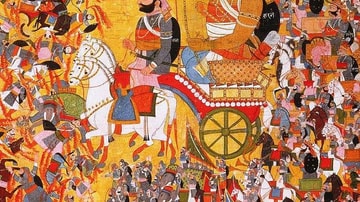
Mahabharata
The Mahabharata is an ancient Indian epic where the main story revolves around two branches of a family - the Pandavas and Kauravas - who, in the Kurukshetra War, battle for the throne of Hastinapura. Interwoven into this narrative are several...

Definition
Parthian Religion
Parthian religion might be best described with two words: inclusive and evolving. As Parthia's empire held within it a variety of cultures, the Parthians wisely left each to their own beliefs and traditions, like the Seleucid Empire and the...

Definition
Fates
The Fates (also known as the Moirai in Greek mythology) are three sister goddesses responsible for assigning destinies to mortals at their birth, a human's lifespan, and the timing of their death. The golden thread they spin represents each...

Definition
Ixion - The Man Who Was Tied to an Ever-Spinning Wheel
Ixion is the fiendishly wicked king of the Lapiths from Greek mythology. In an attempted seduction of Hera, he was tricked by Zeus into making love to a cloud instead, from which was born Centaurus, the founder of the race of centaurs. Ixion's...

Definition
Arachne
Arachne, from the Greek arákhnē (meaning spider), is a figure in Greek mythology whose talent for weaving was renowned and who famously challenged the goddess Minerva to a weaving competition. As told in Ovid’s (43 BCE-17 CE) Metamorphoses...

Definition
Idunn
Idunn (pronounced Ih-dune) is a fertility goddess in Norse mythology who holds the apples of eternal youth the gods rely on to remain young and healthy. The Norse gods were not immortal – they just lived very long lives – and the apples of...

Article
Ancient Greek Clothing
Ancient Greek clothing developed from the Minoan Civilization of Crete (2000-1450 BCE) through the Mycenean Civilization (1700-1100 BCE), Archaic Period (8th century to c. 480 BCE) and is most recognizable from the Classical Period (c. 480-323...
