
Search
Remove Ads
Advertisement
Search Results
Article
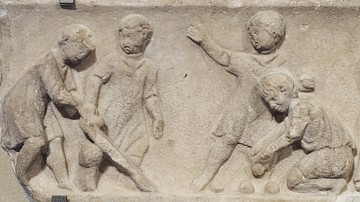
Childhood in Ancient Rome
Freeborn Roman children, ingenuiae, born of Roman citizen parents lived a life that was dictated by the level of society into which they were born; a day in the life of a child from the lower level of society and one from the more affluent...

Article
Inca Textiles
For the Incas finely worked and highly decorative textiles came to symbolize both wealth and status, fine cloth could be used as both a tax and currency, and the very best textiles became amongst the most prized of all possessions, even more...

Article
Discovery of X-Rays
The discovery of X-rays – a form of invisible radiation that can pass through objects, including human tissue – revolutionised science and medicine in the late 19th century. Wilhelm Conrad Röntgen (1845-1923), a German scientist, discovered...

Article
A Visual Who's Who of Greek Mythology
Achilles The hero of the Trojan War, leader of the Myrmidons, slayer of Hector and Greece's greatest warrior, who sadly came unstuck when Paris sent a flying arrow guided by Apollo, which caught him in his only weak spot, his heel. Adonis...

Article
Trade Unions in the British Industrial Revolution
Trade unions were formed in Britain during the Industrial Revolution (1760-1840) to protect workers from unnecessary risks using dangerous machines, unhealthy working conditions, and excessive hours of work. The trade union movement was vigorously...

Article
The Women of Athena's Cult
In ancient Athens, women had no life outside the home unless they were prostitutes or were engaged in religious activities such as festivals. Every Greek deity in every city-state had their own cult (sect) but the cult of Athena offered women...

Article
The Reforms of Peter the Great
Peter I of Russia (Peter the Great, l. 1672-1725) was the Tsar of Russia from 1682 to 1721 and the Emperor of Russia from 1721-1725. The lasting impression of Peter's long reign is the significant changes he brought to Russia due to his various...

Article
Women in the Byzantine Empire
Women in the Byzantine Empire (4th to 15th century CE) were, amongst the upper classes, largely expected to supervise the family home and raise children while those who had to work for a living did so in most of the industries of the period...
Article
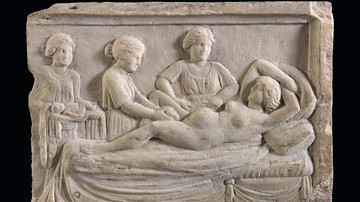
Childbirth in Ancient Rome
Childbirth in ancient Rome was considered the main purpose of marriage. Roman girls married in their early teens, and in elite society, some married before they reached puberty. The legal age for marriage was 12 for a girl; 15 was accepted...

Article
Peasant Life in a Medieval Manor - The Family of Bodo, Carolingian Farmers
Bodo was a early 9th-century Frankish farmer. He and his family hailed from a manor owned by the monastery of St.-Germain-des-Prés near Paris and worked as its tenants. He ploughed the farmlands while his wife, Ermentrude, took care of their...
