
Search
Remove Ads
Advertisement
Search Results

Definition
Ancient Egypt - The Land of the Gods of Balance and Harmony
Egypt is a country in North Africa, on the Mediterranean Sea, and is home to one of the oldest civilizations on Earth. The name "Egypt" comes from the Greek Aegyptos, which was the Greek pronunciation...

Definition
Suppiluliuma I
Suppiluliuma I (1344-1322 BCE) is considered the most powerful and impressive king of the Hittite Empire. He was the son of Tudhaliya II (also known as Tudhaliya III) and is credited with founding the New Kingdom of the Hittites...
Definition
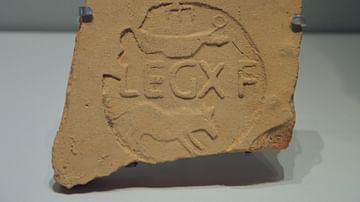
Legio X Fretensis
Legio X Fretensis was a legion of the Roman army formed by either Julius Caesar or Augustus. The legion spent most of its existence in the East, primarily in Judea. It participated in Corbulo’s two Armenian campaigns as well...

Video
A Short History of Assyria and the Neo-Assyrian Empire
Assyria has a long history, beginning in northern Mesopotamia and then expanding during the Neo-Assyrian Empire from Mesopotamia through Asia Minor, and down through Egypt. The empire began in the...

Definition
Order of the Garter
The Most Noble Order of the Garter is the highest order of knighthood in Britain and the most exclusive with traditionally only 24 knights as full members at any one time, along with the reigning monarch and the Prince of Wales...

Definition
James IV of Scotland
James IV of Scotland ruled as king from 1488 to 1513. He succeeded his father James III of Scotland (r. 1460-1488) and became one of the most popular of the Stuart kings. James sought to apply justice in every corner of his...

Definition
Henry VI of England
Henry VI of England ruled as king from 1422 to 1461 and again from 1470 to 1471. Succeeding his father Henry V of England (r. 1413-1422), Henry VI was crowned the king of France in 1431 but he could not prevent a French revival...

Definition
Urartu Civilization
Urartu, also known as the Kingdom of Urartu or the Kingdom of Van, was a civilization which developed in the Bronze and Iron Age of ancient Armenia, eastern Turkey, and northwestern Iran from the 9th century BCE. Controlling...

Definition
Byzantine Coinage
The coinage of the Byzantine Empire continued that of its more ancient predecessors and functioned as a convenient method of payment for goods and services, especially to soldiers and officials, and as a means for people to pay...

Definition
Byzantine Emperor
The Byzantine Emperor ruled as an absolute monarch in an institution which lasted from the 4th to 15th century CE. Aided by ministers, high-ranking nobility, and key church figures, the emperor (and sometimes empress) was commander-in-chief...
