
Search
Remove Ads
Advertisement
Search Results

Article
Dynamics of the Neolithic Revolution
The Neolithic Revolution began between 10,000 and 12,000 years ago at several widely dispersed locations across the world, when our ancestors first began planting and raising crops. Agricultural communities sprang...
Article
The Origins of Christian Teachings on Human Sexuality
The Bible is often quoted in the modern discourse concerning human sexuality, gender identification, same-sex marriages, birth control, and especially abortion. However, most modern Christian teaching...

Article
Trade Goods of the East India Company
The English East India Company (EIC) was founded in 1600, and it came to control both trade and territories in India, as well as a trade monopoly with China. Goods the EIC traded included spices, cotton cloth...

Article
Fall of Maximilien Robespierre
The fall of Maximilien Robespierre, or the Coup of 9 Thermidor, was a series of events that resulted in the arrests and executions of Robespierre and his allies on 27-28 July 1794. It signaled the end of the Reign...

Article
The Death of David 'Davy' Crockett at the Alamo - José Enrique de la Peña's Account of the Surrender
The death of David 'Davy' Crockett at the Battle of the Alamo (6 March 1836) has been understood as a heroic last stand at least since 1880 when Texan historian...

Article
Minoan Frescoes
Frescoes are the source of some of the most striking imagery handed down to us from the Minoan civilization of Bronze Age Crete (2000-1500 BCE). Further, without written records, they are often the only source, along with decorated...

Article
The Monastic Movement: Origins & Purposes
In 313 CE, Constantine the Great (272 – 337 CE) ended the sporadic-yet-terrifying Christian persecutions under the Roman Empire with his “Edict of Milan,” and brought the Christian church under imperial protection...

Image
Map of the Voyage of Aeneas from Troy to the Origins of Rome - The Mediterranean Journey in Virgil’s Aeneid
The voyage of Aeneas, Trojan prince and hero of The Aeneid, belongs to Rome’s foundation mythology rather than historical record. Composed by Virgil (70–19...

Image
Pompeii Fresco with Lares
Fresco depicting two Lares (protective deities, sons of the god Mercury) pouring wine from a drinking horn (rhyton) into a bucket (situla). They stand on either side of a scene of sacrifice. The head of the family makes...
Image
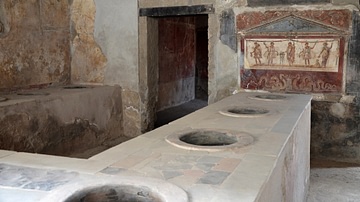
The Thermopolium of Vetutius Placidus in Pompeii
The thermopolium (cook-shop) of Vetutius Placidus in Pompeii. Thermapolia were bars which served hot food and drinks. The 'L' shaped masonry counter has large storage jars which were used to hold food...
