
Search
Remove Ads
Advertisement
Search Results

Image
The Four Castes of Ancient India - The Varna System
This infographic illustrates the Varna caste system in ancient India. First mentioned in the Rig Veda's Purusha Sukta c. 1200–1000 BCE, it shows society divided into four groups that emerged from the...
Collection
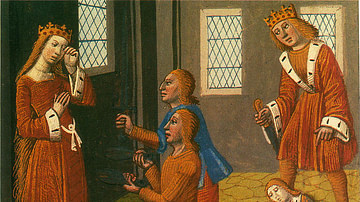
Merovingian Kings & Queens
The Merovingians were the ruling family of the Franks from roughly 481 CE, when Clovis I rose to power, until 751, when the last Merovingian king was overthrown and supplanted by the Carolingian Dynasty. They established...
Article
The Tale of the Shipwrecked Sailor: An Egyptian Epic
The Tale of The Ship-Wrecked Sailor is a text dated to the Middle Kingdom of Egypt (2040-1782 BCE). It is a story of adventure whose purpose, besides entertainment, would have been to impress upon...

Definition
Xochipilli
Xochipilli or the 'Prince of Flowers' was the Mesoamerican god of summer, flowers, pleasure, love, dancing, painting, feasting, creativity and souls. He is a benevolent manifestation of Piltzintecuhtli, the young sun god who was himself...

Definition
Tezcatlipoca - The Greatest of Aztec Gods
Tezcatlipoca (pron. Tez-ca-tli-po-ca) or 'Smoking Mirror' in Nahuatl was one of the most important gods in Postclassical Mesoamerican culture and particularly important for the Toltecs and the Aztecs, especially...

Definition
Coatlicue
Coatlicue (pron. Co-at-li-cu-e) or 'Serpent Skirt' was a major deity in the Aztec pantheon and regarded as the earth-mother goddess. Coatlicue is represented as an old woman to symbolise the antiquity of earth worship. Coatlicue was...

Definition
Mictlantecuhtli
Mictlantecuhtli (pron. Mict-lan-te-cuht-li) or 'Lord of the Land of the Dead' was the Aztec god of death. He ruled the underworld (Mictlán) with his wife Mictecacíhuatl. Mictlantecuhtli was worshipped and feared across Mesoamerica...

Definition
Huitzilopochtli
Huitzilopochtli (pron. Huit-zi-lo-pocht-li) or 'Hummingbird of the South' or 'Blue Hummingbird on the Left' was one of the most important deities in the Aztec pantheon and for the Méxica he was the supreme god. He was the god...

Article
The Tizoc Stone
The Tizoc Stone is a huge stone cylinder from the Aztec capital of Tenochtitlan which depicts a sun-disk on its flat upper surface and carries a frieze around its outer edge showing Aztec warriors and the Aztec king Tizoc, whose...
Article
Aztec Pantheon
The gods of the Aztecs (1345-1521 CE) were many and varied and, as with many other ancient cultures, deities were closely associated with things and events important to the culture and the general welfare of the community. These...
