
Search
Remove Ads
Advertisement
Search Results

Definition
Battle of Thermopylae
Thermopylae is a mountain pass near the sea in northern Greece which was the site of several battles in antiquity, the most famous being that between Persians and Greeks in August 480 BCE. Despite being greatly inferior in...
Definition
Aquileia
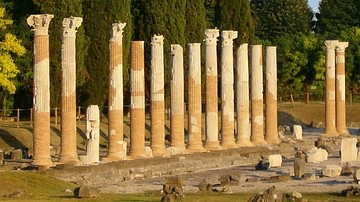
The ancient city of Aquileia was situated near the head of the Adriatic Sea west of the Roman province of Illyria. The strategic location of the city served a crucial role in the expansion of the Roman Republic by serving as a buffer...

Definition
Column
The column was an architectural invention that allowed for the support of ceilings without the use of solid walls. Columns increase the space which can be spanned by a ceiling, allowing the entrance of more light. Columns also offer an...

Definition
Greek Architecture
Greek architecture is concerned with simplicity, proportion, perspective, and harmony in buildings. Greek architecture includes some of the finest and most distinctive buildings ever built. Examples of Greek architecture include...

Definition
Nazca Civilization
The Nazca civilization flourished on the southern coast of Peru between 200 BCE and 600 CE. They settled in the Nazca and other surrounding valleys with their principal religious and urban sites being Cahuachi and Ventilla...

Definition
Sargonid Dynasty
The Sargonid Dynasty was the last ruling house of the Neo-Assyrian Empire from 722-612 BCE, beginning with the reign of Sargon II and ending with fall of the Neo-Assyrian Empire. Some of the most famous kings in the history of...

Definition
Gupta Empire
The Gupta Empire stretched across northern, central and parts of southern India between c. 320 and 550 CE. The period is noted for its achievements in the arts, architecture, sciences, religion, and philosophy. Chandragupta I (320...

Definition
Ravana
Ravana is the mythical multi-headed demon-king of Lanka in Hindu mythology. With ten heads and twenty arms, Ravana could change into any form he wished. Representing the very essence of evil, he famously fought and ultimately lost a series...

Definition
Kofun Period
Following the Yayoi Period of Japan when farming and metalworking techniques were introduced from mainland Asia was the Kofun Period (c. 250 CE - 538 CE) where the religion of Shinto emerges from the beliefs of previous eras and...
Definition
Etruscan Pottery
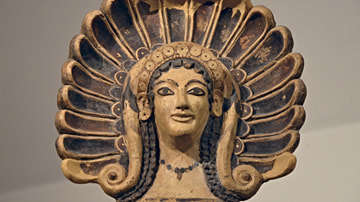
Etruscan pottery, produced over five centuries, was nothing if not varied. Indigenous wares such as the glossy black bucchero were made alongside red- and black-figure pottery imitating, yet modifying those produced in the Greek...
