
Search
Remove Ads
Advertisement
Search Results
Image
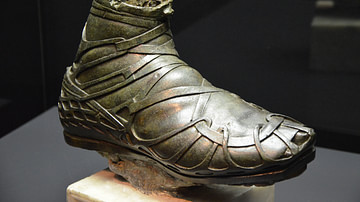
Bronze caliga from an over life-size statue of a Roman cavalryman
This bronze caliga was part of an over life-size statue of a Roman cavalryman from the 1st or the 2nd century CE. Caligae were heavy hob-nailed military boots worn by Roman legionary soldiers...

Image
Map of Roman & Parthian Trade Routes
This map shows the Roman-Parthian trade route system, circa between the 1st and the 3rd centuries CE. During this period, the Roman Empire and the Parthian Empire were the two superpowers of the region and the...
Image
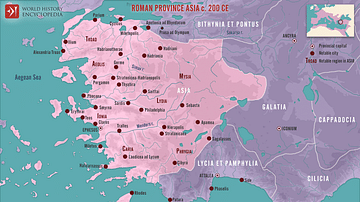
Roman Province Asia c. 200 CE
This map illustrates the Roman province of Asia around 200 CE. Established in 129 BCE following the bequest of the Attalid Kingdom of Pergamon to Rome, it encompassed western Anatolia (modern-day Turkey). It was a wealthy...

Definition
Leon Battista Alberti
Leon Battista Alberti (1404-1472 CE) was an Italian scholar, architect, mathematician, and advocate of Renaissance humanism. Alberti famously wrote the treatise On Architecture where he outlines the key elements of classical...

Definition
Gaius Cassius Longinus - Liberator, Tyrannicide, or Traitor?
Gaius Cassius Longinus (circa 86-42 BCE) was a leader of the 'Liberators', the faction of Roman senators who assassinated Julius Caesar on the Ides of March (15 March) 44 BCE. Motivated by a...
Definition
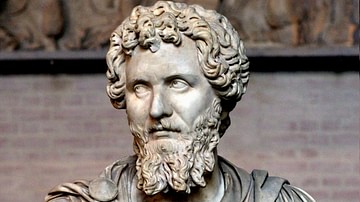
Septimius Severus
Lucius Septimius Severus was Roman emperor from April 193 to February 211 CE. He was of Libyan descent from Lepcis Magna and came from a locally prominent Punic family who had a history of rising to senatorial as well as consular...

Definition
Praetor
A praetor was a senior magistrate in ancient Roman government, who was granted executive or imperium powers similar to that of the consuls. Although originally assigned legal authority over the courts, his executive powers allowed him...

Article
The Gifts of Isis: Women's Status in Ancient Egypt
An inscription on an Egyptian papyrus dating from the 2nd century CE relates that the goddess Isis, bestowing gifts on humanity at the beginning of time, gave as much power and honor to women as she...
Image
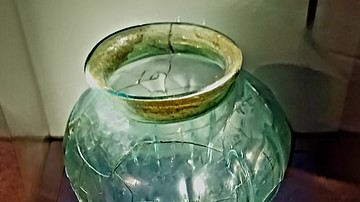
Roman Blue-Glass Cinerary Urn from Luguvalium
Roman blue-glass cinerary urn, from Luguvalium (Botchergate, Carlisle), 1st century CE. Carlisle Cathedral. Burning the body after death and keeping the bones and ashes in the cineraria (funerary urns...

Image
The Five Good Emperors of the Roman Empire (96 - 180 CE)
This infographic illustrates the succession of Roman emperors from 96 to 180 CE, commonly referred to as the Five Good Emperors - Nerva, Trajan, Hadrian, Antoninus Pius, and Marcus Aurelius. This...
