
Search
Did you mean: Roman Art?
Remove Ads
Advertisement
Search Results

Definition
Andromeda
Andromeda is a princess in Greek mythology. She is the daughter of Cepheus, the king of Aethiopia (Ethiopia), and his wife, Cassiopeia. The most famous myth associated with Andromeda is the story of her rescue by the Greek hero Perseus...

Definition
Great Sioux War
The Great Sioux War (also given as the Black Hills War, 1876-1877) was a military conflict between the allied forces of the Lakota Sioux/Northern Cheyenne and the US government over the territory of the Black Hills and, more widely...

Definition
George H. Thomas - The Underrated Hero of the Union
George H. Thomas (1816 to 1870) was a Union general in the American Civil War who first came to national attention after his victory at the Battle of Mill Springs (19 January 1862) in Kentucky, the...
Definition
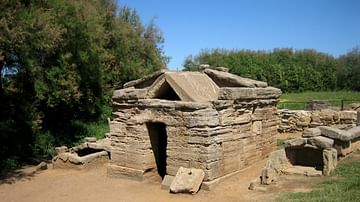
Populonia
Populonia (Etruscan name: Pupluna or Fufluna), located on the western coast of Italy, was an important Etruscan town which flourished between the 7th and 2nd century BCE. Rich in metal deposits and so noted for its production of pig...

Article
Cultural Links between India & the Greco-Roman World
Cyrus the Great (558-530 BCE) built the first universal empire, stretching from Greece to the Indus River. This was the famous Achaemenid Empire of Persia. An inscription at Naqsh-i-Rustam, the tomb...

Definition
Egyptian Faience
Egyptian faience is a glassy substance manufactured expertly by the ancient Egyptians. The process was first developed in Mesopotamia, first at Ur and later at Babylon, with significant results but faience production reached its...

Definition
Ancient Persian Culture
Ancient Persian culture flourished between the reign of Cyrus II (The Great, r. c. 550-530 BCE), founder of the Achaemenid Persian Empire, and the fall of the Sassanian Empire in 651 CE. Even so, the foundations of Persian...

Definition
Pietro Perugino
Pietro Perugino (c. 1450-1523), real name Pietro di Cristoforo Vannucci, was an Italian Renaissance artist who created frescoes for the Vatican's Sistine Chapel and was in demand across Italy to decorate church interiors and produce...

Article
Trade in Ancient Celtic Europe
Trade in raw materials and manufactured goods in ancient Celtic Europe was vibrant and far-reaching, particularly regarding the centre of the continent where there was a hub of well-established trade routes. As the...

Article
Renaissance Altarpieces
During the Renaissance (1400-1600) just about any artist of worth found themselves commissioned at some point in their careers to produce an altarpiece. Some of the greatest names in European art were so called upon, from...
