
Search
Did you mean: Ramesses II?
Remove Ads
Advertisement
Search Results
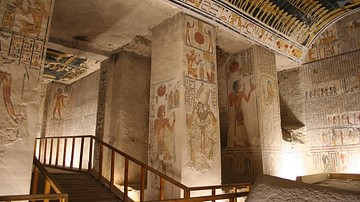
Image
Tomb of Ramesses V
Valley of the Kings, Egypt, Tomb KV9.

Definition
Colossi of Memnon
The Colossi of Memnon (also known as el-Colossat or el-Salamat) are two monumental statues representing Amenhotep III (1386-1353 BCE) of the 18th Dynasty of Egypt. They are located west of the modern city of Luxor and face east...

Video
Ramesses II, Egypt, c. 1250
More free lessons at: http://www.khanacademy.org/video?v=PXUKfJ4XDk4 Ramesses II, Herakleopolis (Temple of Harsaphes), New Kingdom, Egypt, c. 1250 B.C.E. (University of Pennsylvania Museum of Archaeology and Anthropology...

Interview
Interview: Egyptian Mythology by Garry Shaw
World History Encyclopedia is joined by Egyptologist and author Garry Shaw to chat about his new book Egyptian Mythology: A Traveller's Guide from Aswan to Alexandria. Kelly (WHE): Do you want to start with...

Article
Mummification in Ancient Egypt
The practice of mummifying the dead began in ancient Egypt c. 3500 BCE. The English word mummy comes from the Latin mumia which is derived from the Persian mum meaning 'wax' and refers to an embalmed corpse which was...

Definition
Hatshepsut
Hatshepsut (r. 1479-1458 BCE) was the first female ruler of ancient Egypt to reign as a male with the full authority of pharaoh. Her name means "Foremost of Noble Women" or "She is First Among Noble Women". She began her reign as...

Article
The Temple of Hatshepsut
Among the duties of any Egyptian monarch was the construction of monumental building projects to honor the gods and preserve the memory of their reigns for eternity. These building projects were not just some grandiose...

Definition
Assyria
Assyria was the region located in the ancient Near East which, under the Neo-Assyrian Empire, reached from Mesopotamia (modern-day Iraq) through Asia Minor (modern Turkey) and down through Egypt. The empire began modestly at the city...

Definition
Neo-Assyrian Empire
The Neo-Assyrian Empire (912-612 BCE) was the final stage of the Assyrian Empire, stretching throughout Mesopotamia, the Levant, Egypt, Anatolia, and into parts of Persia and Arabia. Beginning with the reign of Adad Nirari...

Article
Pirates of the Mediterranean
The pirates of the ancient Mediterranean were not, for the most part, the outsiders who knew no country's allegiance and were the enemies of civilization as they are frequently depicted in novels and other media. They...
