
Search
Did you mean: Ramesses II?
Remove Ads
Advertisement
Search Results
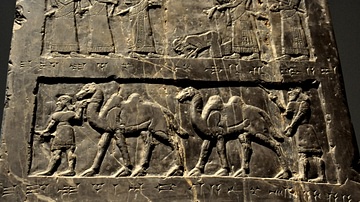
Image
The Black Obelisk of Shalmaneser III, side A, 3rd register
Attendants bring tribute from Musri with two-humped camels. Musri, meaning a borderland, probably refers to a country in eastern Iran or in Egypt. From Nimrud, (ancient Kalhu), near the building...

Definition
Seleucid Empire
The Seleucid Empire (312-63 BCE) was the vast political entity established by Seleucus I Nicator ("Victor" or "Unconquered", l. c. 358-281 BCE, r. 305-281 BCE), one of the generals of Alexander the Great who claimed a part of...

Definition
Ancient Egyptian Vizier
The vizier in ancient Egypt was the most powerful position after that of king. Known as the djat, tjat, or tjati in ancient Egyptian, a vizier was the equivalent of the modern-day prime minister of the nation who actually...

Definition
Egyptian Obelisk
An obelisk is a stone rectangular pillar with a tapered top forming a pyramidion, set on a base, erected to commemorate an individual or event and honor the gods. The ancient Egyptians created the form at some point in the Early...
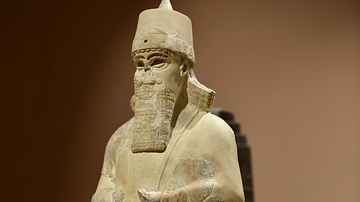
Image
Statue of Shalmaneser III from Nimrud
This statue represents Shalmaneser III (reigned 858-824 BCE) and was found by a peasant accidentally in the early spring of 1956. It was badly fragmented at the south-east corner of Nimrud city wall, at the foot...

Image
The Black Obelisk of King Shalmaneser III
This obelisk was erected as a public monument in 825 BCE at a time of civil war. The relief sculptures glorify the achievements of King Shalmaneser III and his commander-in-chief . It lists their military campaigns...
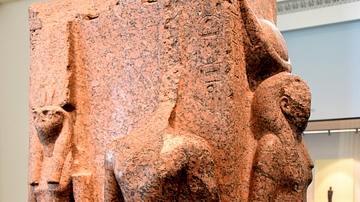
Image
Sculpture of King Thutmose III
This is a rare example of an Egyptian temple sculpture, in which the figures face in 4 different directions. This suggests that it stood in the middle of a room. Three persons are represented twice. King Thutmose III...
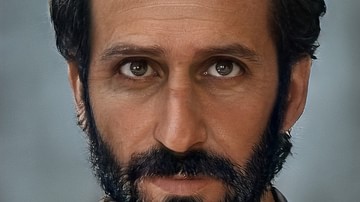
Image
Darius III (Artistic Facial Reconstruction)
A photorealistic representation of the Persian king Darius III (r. 336-330 BCE) as he may have appeared. This reconstruction is largely based on artistic evidence like the Alexander Mosaic (c. 100 BCE) and...

Image
Red Granite Offering Table of King Senusret III
Offerings were placed upon a reed mat, reproduced in stone as the offering tables of the Dynastic periods. On this royal example, the hieroglyph hetep "offering" is written on the surface. The sign comprises...

Image
Statue of Shalmaneser III
Statue of the Assyrian king Shalmaneser III, son of Ashurnasirpal II, grandson of Tikulti-Ninurta. The inscriptions on the statue give a brief account of the king's genealogical titles and characteristics. Basalt...
