
Search
Did you mean: Tara?
Remove Ads
Advertisement
Search Results

Definition
Legalism
Legalism in ancient China was a philosophical belief that human beings are more inclined to do wrong than right because they are motivated entirely by self-interest and require strict laws to control their impulses. It was developed...

Definition
Ancient India
India is a country in South Asia whose name comes from the Indus River. The name 'Bharata' is used as a designation for the country in their constitution referencing the ancient mythological emperor, Bharata, whose story is told...

Definition
Djed
The djed is an ancient Egyptian symbol for stability which features prominently in Egyptian art and architecture throughout the country's history. `Stability' should be understood to mean not only a firm footing but immutability and permanance...

Definition
Mesopotamia - The Beginning of Beginnings
Mesopotamia (from the Greek, meaning "between two rivers") was an ancient region located in the Near East (Middle East) bounded in the northeast by the Zagros Mountains and in the southeast by the Arabian Plateau...

Definition
Ancient Chinese Warfare
In ancient China warfare was a means for one region to gain ascendancy over another, for the state to expand and protect its frontiers, and for usurpers to replace an existing dynasty of rulers. With armies consisting of...

Definition
Brennus
Brennus (c. 390 BCE) was the Gallic war chief of the Senones who sacked and occupied Rome in 390 BCE. Nothing is known of him outside of the accounts given of this event which immortalized him as coining the phrase, “Woe to the Vanquished”...

Definition
Harsha
Emperor Harshavardhana, better known as Harsha, lived from 590 to 647 CE and was the last ruler of the Vardhana Empire, the last great empire in ancient India before the Islamic Invasion. He ruled from 606 CE to 647 CE. After Harshavardhana's...
Definition
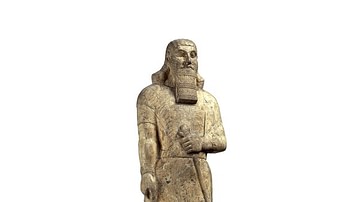
Ashurnasirpal II
Ashurnasirpal II (r. 884-859 BCE) was the third king of the Neo-Assyrian Empire. His father was Tukulti-Ninurta II (r. 891-884 BCE) whose military campaigns throughout the region provided his son with a sizeable empire and the...

Definition
Chinese Literature
Chinese literature is among the most imaginative and interesting in the world. The precision of the language results in perfectly realized images whether in poetry or prose and, as with all great literature, the themes are timeless...

Definition
Macedon - Birthplace of Alexander the Great
Macedon was an ancient kingdom located in the north of the Greek peninsula first inhabited by the Mackednoi tribe whose identity was challenged by some southern Greeks but who, according to Herodotus (5:22...
