
Search
Remove Ads
Advertisement
Search Results
Definition
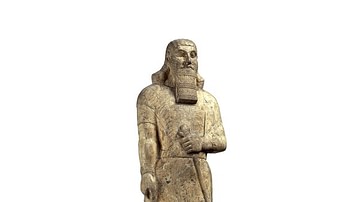
Ashurnasirpal II
Ashurnasirpal II (r. 884-859 BCE) was the third king of the Neo-Assyrian Empire. His father was Tukulti-Ninurta II (r. 891-884 BCE) whose military campaigns throughout the region provided his son with a sizeable empire and the...

Definition
Oppidum - The Hilltop Fort of the Celts
Celtic hilltop forts, often called oppida (sing. oppidum), after the Latin name given to larger settlements by the Romans, were built across Europe during the 2nd and 1st century BCE. Surrounded by a fortification...

Definition
Adad Nirari I
Adad Nirari I (r. 1307-1275 BCE) was the king of the Assyrian Empire who initiated the first major expansion of the Assyrian kingdom from the city of Ashur throughout the region of Mesopotamia. He also instituted what would become...

Definition
Moses
Moses (c. 1400 BCE) is considered one of the most important religious leaders in world history. He is claimed by the religions of Judaism, Christianity, Islam, and Bahai as an important prophet of God and the founder of monotheistic belief...

Definition
Ancient Japan
Ancient Japan has made unique contributions to world culture which include the Shinto religion and its architecture, distinctive art objects such as haniwa figurines, the oldest pottery vessels in the world, the largest wooden buildings...

Definition
Tarascan Civilization
The Tarascan civilization (aka the Purépecha, after their language) dominated western Mexico and built an empire that would bring it into direct conflict with that other great Mesoamerican civilization of the Post-classic...

Definition
Kingdom of Jerusalem
The Kingdom of Jerusalem was a state created in 1099 CE by Crusaders and western settlers after the First Crusade (1095-1102 CE). With Jerusalem as its capital, the kingdom was the most important of the four Crusader States...

Definition
Ancient China
Ancient China produced what has become the oldest extant culture in the world. The name 'China' comes from the Sanskrit Cina (derived from the name of the Chinese Qin Dynasty, pronounced 'Chin') which was translated as 'Cin' by...

Article
Justinian's Plague (541-542 CE)
During the reign of the emperor Justinian I (527-565 CE), one of the worst outbreaks of the plague took place, claiming the lives of millions of people. The plague arrived in Constantinople in 542 CE, almost a year...

Article
Indigenous Intercultural Health in Chile
Since the return to democracy in Chile in 1990 CE, the new governments have dealt with one of the great historical debts of the Chilean state, its relationship with the indigenous peoples. These peoples have...
