
Search
Remove Ads
Advertisement
Search Results

Definition
Neodamodeis
A huge part of the Spartan population was made up of those who were not actually Spartan, the helots; a cause of great concern to the Spartans throughout their history. These helots were slaves that were usually captives of the Spartans...

Definition
Ancient Greek Government
Ancient Greece witnessed a wide variety of government systems as people searched for the answers to such fundamental questions as who should rule and how? Should sovereignty lie in the rule of law, the constitution, officials...

Definition
Ostia
Ostia (or Ostia Antica) lies 15 km from the city of Rome for which it served as the city's principal port and harbour throughout antiquity. The name derives from 'os' or 'ostium' which means 'mouth' and refers to the city's location at...

Definition
Maya Architecture
Maya architecture is best characterized by the soaring pyramid temples and ornate palaces which were built in all Maya centres across Mesoamerica from El Tajin in the north to Copan in the south. The Maya civilization was formed...
Definition
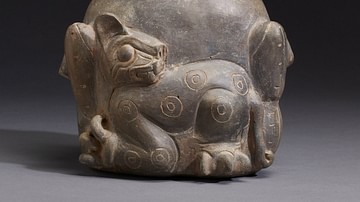
Chavin Civilization
The Chavin civilization flourished between 900 and 200 BCE in the northern and central Andes and was one of the earliest pre-Inca cultures. The Chavin religious centre Chavin de Huantar became an important Andean pilgrimage...

Definition
The Thirty Tyrants
The Thirty Tyrants (οἱ τριάκοντα τύραννοι) is a term first used by Polycrates in a speech praising Thrasybulus (Arist. Rhet. 1401a) to describe the brief 8-month oligarchy which governed Athens after the Peloponnesian War –...
Definition
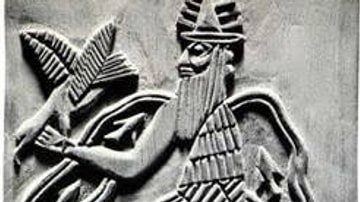
Enki - The Tricky Sumerian God of Wisdom
Enki (also known as Ea, Enkig, Dis, Nagbu, Nissiku Nudimmud) was the Sumerian god of wisdom, freshwater, intelligence, trickery and mischief, crafts, magic, exorcism, healing, creation, virility, fertility...

Definition
Agesilaus II
Agesilaus II (c. 445 – 359 BCE) was a Spartan king who won victories in Anatolia and the Corinthian Wars but who would ultimately bring total defeat to his city through his policies against Thebes. When Sparta lost the crucial battle...

Definition
Etruscan Art
The art of the Etruscans, who flourished in central Italy between the 8th and 3rd century BCE, is renowned for its vitality and often vivid colouring. Wall paintings were especially vibrant and frequently capture scenes of Etruscans...

Definition
Ancient Egyptian Warfare - The Force That Built an Empire
Ancient Egyptian Warfare developed from an army of conscripts in the Pre-Dynastic Period (circa 3150-2613 BCE) through the early era of the Middle Kingdom (2040-1782 BCE), supplied to the king by...
