
Search
Remove Ads
Advertisement
Search Results
Article
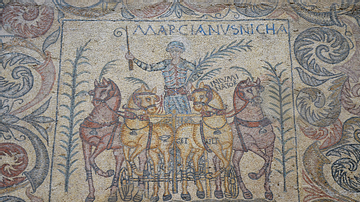
Chariot Racing in Ancient Rome
Chariot racing was very big business in ancient Rome. There was a whole industry built around the factions, the four professional stables known by their team colour – Blue, Green, Red, and White –, providing all that...
Article
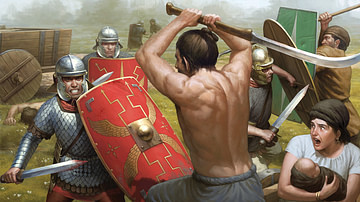
Legions of the Dacian Wars
The Dacian Wars started after Decebalus (r. c. 87-106 CE) raided the Roman province of Moesia in 85 CE. Emperor Domitian's (r. 81-96 CE) Dacian campaigns in 86-87 CE reached an uneasy peace, but the conflict was renewed...

Definition
Cimbri
The Cimbri were a tribe who lived in northern Jutland during the Roman era. Their ethnicity is enigmatic; scholars generally believe that the Cimbri were Germans, though others maintain that they were Celts. The late 2nd-century BCE migration...

Definition
Gildas
Gildas (c. 500-570 CE) was a Romano-British monk, known primarily for a work entitled De Excidio et Conquestu Britanniae, translated as On the Ruin and Conquest of Britain. Gildas' work is a polemical sermon recounting British history...

Definition
Ostia
Ostia (or Ostia Antica) lies 15 km from the city of Rome for which it served as the city's principal port and harbour throughout antiquity. The name derives from 'os' or 'ostium' which means 'mouth' and refers to the city's location at...

Definition
Roman Emperor
Roman emperors ruled the Roman Empire starting with Augustus in 27 BCE and continuing in the West until the late 5th century CE and in the Eastern Roman Empire up to the mid-15th century CE. The emperors took titles such as Caesar...

Article
Caesar As Dictator: His Impact on the City of Rome
Gaius Julius Caesar (100-44 BCE) first assumed the role of dictator in 49 BCE, however, once he had secured his election as consul for the following year, he resigned after 11 days. After defeating...

Article
Exploring Roman Morocco
Morocco, then known as Mauretania, was annexed by the Roman Empire in 40 CE. The Romans in Morocco left a vast legacy with archaeological sites that dot the country's northern landscape, especially Volubilis, with its vestiges...

Article
The Principate of Augustus
Augustus (r. 27 BCE to 14 CE), as the adopted son and heir of Julius Caesar (100-44 BCE), brought an end to the Roman Republic, and on 16 January 27 BCE, by Senatorial decree, he became the first Roman emperor. However...
Definition
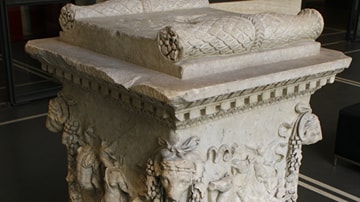
Roman Religion
In many societies, ancient and modern, religion has performed a major role in their development, and the Roman Empire was no different. From the beginning Roman religion was polytheistic. From an initial array of gods and spirits...
