
Search
Remove Ads
Advertisement
Search Results

Image
Greco-Persian Wars
The Greco-Persian Wars or Persian Wars were a series of battles in the 5th century BCE between Greece and Persia. This series of wars consisted of some famous battles; Marathon, Thermopylae, Salamis and Plataea which resulted...

Definition
Pezhetairoi
The pezhetairoi (foot companions) were part of the imposing army that accompanied the Macedonian commander Alexander the Great (r. 336-323 BCE) when he crossed the Hellespont to face the Persian king Darius III in 334 BCE. Armed with...

Definition
Persepolis
Persepolis was the capital of the Persian Achaemenid Empire from the reign of Darius I (the Great, r. 522-486 BCE) until its destruction in 330 BCE. Its name comes from the Greek Perses-polis (Persian City), but the Persians knew...

Video
Persia & Persian Art at the Louvre
Persian art at the Louvre Museum, Paris, France. There are art pieces from the Royal Palace in Susa from the Achaemenids, the Persian Empire founded by Cyrus the Great (d. 530 BCE). King Darius the Great (r...

Definition
Ctesiphon
Ctesiphon was an ancient city and trade center on the east bank of the Tigris River founded during the reign of Mithridates I (the Great, 171-132 BCE). It is best known in the modern day for the single-span arch, Taq Kasra, which is...
Definition
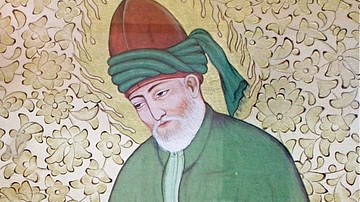
Rumi
Jalal ad-Din Muhammad Rumi (also given as Jalal ad-did Muhammad Balkhi, best known as Rumi, l. 1207-1273 CE) was a Persian Islamic theologian and scholar but became famous as a mystical poet whose work focuses on the opportunity for a...

Definition
Xerxes I
Xerxes I (l. 519-465, r. 486-465 BCE), also known as Xerxes the Great, was the king of the Persian Achaemenid Empire. His official title was Shahanshah which, though usually translated as `emperor', actually means `king of kings'. He...
Image
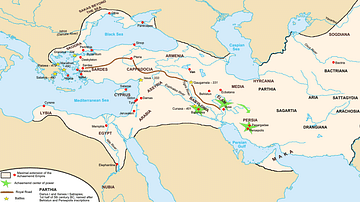
Persian Royal Road
Map of the Persian Royal Road from Susa to Sardes.
Definition
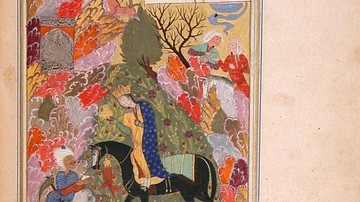
Khamsa of Nizami
Khamsa (also known as Quintet or Panj Ganj) is the best-known work of Nizami Ganjavi (c. 1141-1209 CE) and without a doubt one of the most prominent works of Persian literature. Written during the last decades of the 12th century...
Image
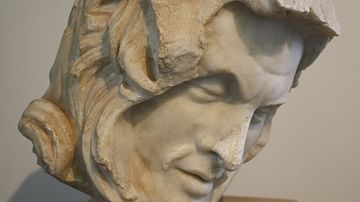
Dying Persian
A marble head depicting a dying Persian. 2nd century CE Roman copy of a Greek 3rd century BCE original. From the Domus Tiberiana, Rome. (Forum Museum, Rome)
