
Search
Remove Ads
Advertisement
Search Results

Image
Persian Poet Nizami
Persian Poet Nizami (l. c. 1141-1209 CE) depicted on a rug.
Ganja Museum, Azerbaijan
Image
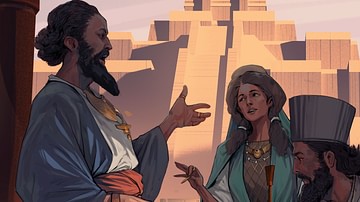
Achaemenid Persian Market Scene
Artist's impression of what a market scene may have looked like in the Achaemenid Persian empire. A ziggurat constructed prior to the Achaemenid period is visible in the background. Created by Amplitude Studios for...
Image
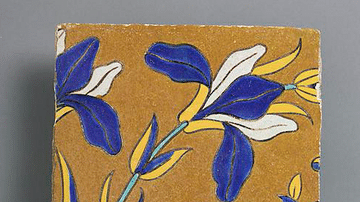
Persian Tiles Showing Iris Plants
Two Persian painted tiles showing Iris plants. c. 1660-70. Painted and glazed terracotta, from an arched wall panel. Isfahan, Iran. (Aga Khan Museum, Toronto, Canada)
Image
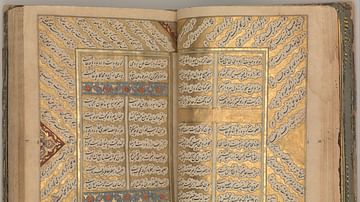
Anthology of Persian Poetry
Anthology of Persian Poetry with the poems of Hafez Shiraz
Folios 33r-32v
Iran, 17th century CE
Image
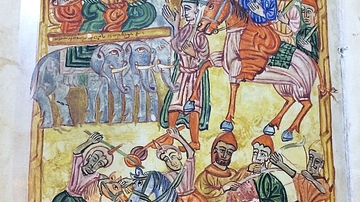
Persian & Armenian Battle Scene
Although this manuscript edition of the "History of Vardan and the Armenian War" was finished in 1569 CE, this illustration shows a battle between the Armenians and the Persians in the 5th century CE. Take special...

Video
The Battle of Pelusium: a Persian Victory Decided by Cats
The Battle of Pelusium was a battle waged between Ancient Egypt under Pharaoh Psametik III and Cambyses II, King of the Achaemenid Persian Empire. The most recognisable feature is the Persian victory...

Video
Ancient Persia and the Achaemenid Persian Empire
The region of ancient Persia, which is modern-day Iran, has one of the longest histories, reaching back to the Palaeolithic Age, some one hundred thousand years ago. Between circa 1500 and 1000 BCE, a...

Video
Persian Art
Images of Persian art accompanied by a poem by Rumi (1207 - 1273 CE) and Persian music.
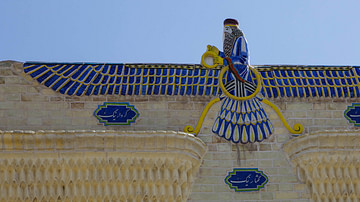
Definition
Zarathustra
Zarathustra (also given as Zoroaster, Zartosht, Zarathustra Spitama, l. c. 1500-1000 BCE) was the Persian priest-turned-prophet who founded the religion of Zoroastrianism (also given as Mazdayasna “devotion to Mazda”), the first monotheistic...

Video
Ancient Persian/Iranian Art
A superb collection of Persian-Iranian Art from a brief visit to the Metropolitan Museum of Art, New York City, USA. Including some Sumerian pieces.
