
Search
Remove Ads
Advertisement
Search Results

Definition
Amastris
Amastris (c. 340/39-285 BCE) was a niece of the Persian king Darius III (r. 336-330 BCE) through her father Oxyathres. She was married in succession to Alexander's general Craterus, the tyrant Dionysius of Heraclea, and finally to Lysimachus...
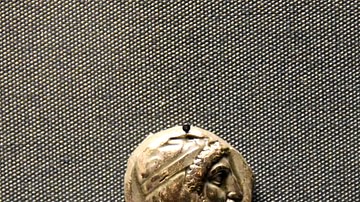
Image
Coin of a Persian Satrap
In the Persian Empire, some regional governors (satraps) were authorized to issue coins for military purposes. They combine Persian and Greek imagery, showing a satrap's head and a local reverse image. These are some of...
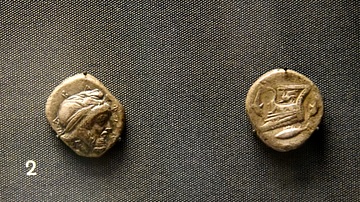
Image
Coins Depicting a Persian Satrap
In the Persian Empire, some regional governors (satraps) were authorized to issue coins for military purposes. They combine Persian and Greek imagery, showing a strap's head and a local reverse image. These are some...

Image
Persian Hero Garshasp
Garshasp kills the dragon, illustration from the Shahnameh, Sultanate of Delhi, c. 1450.
Rietberg Museum, Zürich.
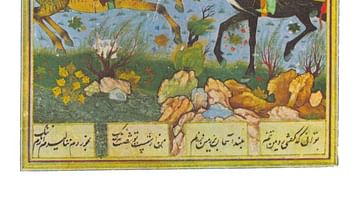
Image
Persian Hero Rustum
Scene from Shahnameh: Rustam (or Rustum) shoots Isfandiyar in the eyes with a double-pointed arrow, from manuscript Ms. or. fol. 4251, Berlin State Library

Article
The Delian League, Part 1: Origins Down to the Battle of Eurymedon (480/79-465/4 BCE)
This text is part of an article series on the Delian League. The modern term Delian League refers to the primarily maritime συμμᾰχία or symmachy (offensive-defensive alliance...
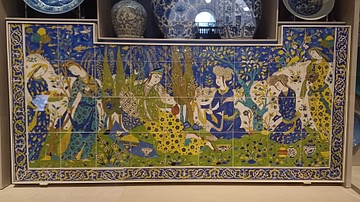
Image
Persian Miniature Tile-Painting of a Garden Scene
Persian miniature painting on a tile, earthenware under coloured glazes, probably from Isfahan, 17th century CE. Victoria and Albert Museum, London. The so-called 'garden scenes' are among the most...

Definition
Behistun Inscription
The Behistun Inscription is a relief with accompanying text carved 330 feet (100 meters) up a cliff in Kermanshah Province, Western Iran. The work tells the story of the victory of the Persian king Darius I (the Great, r...

Image
Map of the Achaemenid Persian Empire c. 500 BCE
The Achaemenid Persian Empire emerged in the mid-6th century BCE when Cyrus II (reign 559–530 BCE) united the Persian tribes and overthrew the Median kingdom (c. 550 BCE), establishing a new imperial state...

Article
Achaemenid Kings List & Commentary
The Achaemenid Empire (c. 550-330 BCE) was the first great Persian political entity in Western and Central Asia which stretched, at its peak, from Asia Minor to the Indus Valley and Mesopotamia through Egypt. It...
