
Search
Remove Ads
Advertisement
Search Results

Definition
Tyche
In Greek mythology, Tyche is the goddess and personification of good luck, chance, and fortune. Tyche's popularity grew after the Classical period when many cities and officials across the Greek world and the Mediterranean adopted her...

Definition
Satyr
Satyrs (aka silens) are figures from Greek mythology who were followers of the god of wine Dionysos. Satyrs were often guilty of excessive sexual desires and overindulgence of wine. Men with a horse's tail and ears or men with goat legs...

Definition
Hatshepsut
Hatshepsut (r. 1479-1458 BCE) was the first female ruler of ancient Egypt to reign as a male with the full authority of pharaoh. Her name means "Foremost of Noble Women" or "She is First Among Noble Women". She began her reign as...

Definition
Hestia
Hestia was the Greek virgin goddess of the hearth, home, and hospitality. In Greek mythology, she is the eldest daughter of Cronus and Rhea. In her role as a protector of the family and political community, sacrifices and offerings were...
Definition
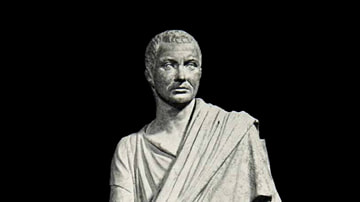
Marcus Claudius Marcellus
Marcus Claudius Marcellus (c. 270-208 BCE) was a five-time consul and, earning the nickname the 'Sword of Rome', he was one of the city's greatest military commanders. Active in both the First and Second Punic Wars, he...

Definition
Tezcatlipoca - The Greatest of Aztec Gods
Tezcatlipoca (pron. Tez-ca-tli-po-ca) or 'Smoking Mirror' in Nahuatl was one of the most important gods in Postclassical Mesoamerican culture and particularly important for the Toltecs and the Aztecs, especially...

Definition
1918 Flu Pandemic - The Deadliest Pandemic in History
The Spanish flu (so-named because the Spanish press openly reported on the outbreak while other World War I belligerents suppressed the news) broke out in March 1918 at Camp Funston, an army camp in...

Definition
Inca Government
The centre of Inca power was the capital Cuzco, considered the navel of the world. 40,000 Incas governed an empire of over 10 million subjects who spoke over 30 different languages. Consequently, the centralised government employed...

Definition
Seshat
Seshat (also given as Sefkhet-Abwy and Seshet) is the Egyptian goddess of the written word. Her name literally means "female scribe" and she is regularly depicted as a woman wearing a leopard skin draped over her robe with a headdress...

Definition
Apollo
Apollo was a Greek god associated with the bow, music, and divination. The epitome of youth and beauty, source of life and healing, patron of the arts, and as bright and powerful as the sun itself, Apollo was perhaps the most loved of...
