
Search
Remove Ads
Advertisement
Search Results

Article
Some new hypotheses on the problems of the Indo-Greek kingdoms
Warning: See the definitions of Greco-Bactrian and Indo-Greek Kingdoms before reading this article, otherwise the following lines could give you serious headaches! A lack of information is...
Article
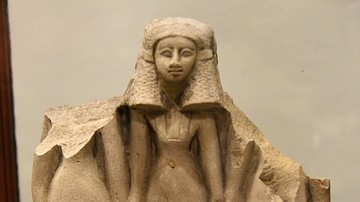
Female Physicians in Ancient Egypt
A famous story from Greece relates how a young woman named Agnodice wished to become a doctor in Athens but found this forbidden. In fact, a woman practicing medicine in Athens in the 4th century BCE faced the death...

Definition
Louis I de Bourbon, Prince of Condé
Louis I de Bourbon (l. 1530-1569) was a descendant of Louis IX of France (r. 1226-1270) and founder of the House of Condé. The Prince of Condé proved his valor as a Huguenot military leader during the first three...

Definition
Visigoth
The Visigoths were the western tribe of the Goths (a Germanic people) who settled west of the Black Sea sometime in the 3rd century CE. According to the scholar Herwig Wolfram, the Roman writer Cassiodorus (c. 485-585 CE) coined the...

Definition
Sabratha
Sabratha was an ancient port city on the coast of North Africa (in modern-day Libya). The site was originally inhabited by the indigenous Berber Zwagha tribe in the 8th century BCE (according to the 11th-century CE historian al-Bakari...

Definition
Galatia
Galatia was a region in north-central Anatolia (modern-day Turkey) settled by the Celtic Gauls c. 278-277 BCE. The name comes from the Greek for "Gaul" which was repeated by Latin writers as Galli. The Celts were offered the region by...

Definition
Ashoka the Great
Ashoka the Great (r. 268-232 BCE) was the third king of the Mauryan Empire (322-185 BCE) best known for his renunciation of war, development of the concept of dhamma (pious social conduct), and promotion of Buddhism as well as...

Definition
Astarte
Astarte is the Canaanite/Phoenician goddess of love, sex, war, and hunting who developed from the Mesopotamian deity Inanna/Ishtar. She is usually associated with the storm god Baal but seems to have been much more popular. She traveled...

Definition
James III of Scotland
James III of Scotland reigned as king from 1460 to 1488. He succeeded his father James II of Scotland (r. 1437-1460) at the age of eight, which led to some nobles taking advantage of the king's minority and even abducting...

Definition
Gnosticism
Gnosticism is the belief that human beings contain a piece of God (the highest good or a divine spark) within themselves, which has fallen from the immaterial world into the bodies of humans. All physical matter is subject to decay...
