
Search
Search Results
Article
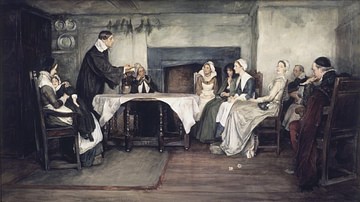
Winthrop & Williams: Religious Persecution & Freedom in New England
The Puritans who settled New England claimed they came to the New World for religious freedom but, once settled, made it clear that this freedom was for themselves only and dissent would not be tolerated. Although the most famous example...
Image
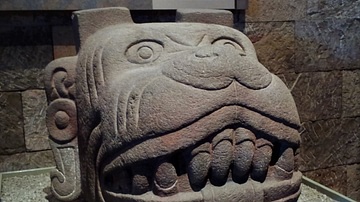
Sculpture of Xolotl, Mexico City
Head of the Aztec god Xolotl. Collection of National Anthropological Museum, Mexico City.
Image
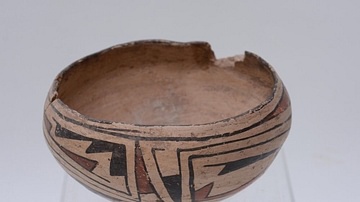
Pottery Bowl from Casas Grandes (Paquimé), Mexico
This pottery bowl comes from Casas Grandes (also known as "Paquimé"), which is located in what's present-day Chihuahua, Mexico. It is made from clay and dates to c. 1250-1400 CE. Casas Grandes was one of the largest and most complex culture...
Image
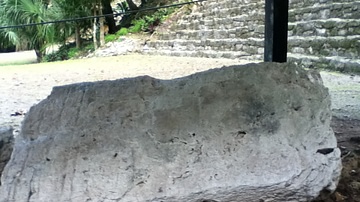
Maya Stele in Grand Plaza Chacchoben, Mexico
Weathered and broken stele in the Grand Plaza of the Maya city of Chacchoben, Mexico, c. 700 CE. It rests at the foot of the stairs leading up to the Gran Basamento plateau where religious rituals were held.

Image
Casas Grandes, Mexico
Ruined house, Casas Grandes or Paquimé, a major pre-Columbian city that flourished due to its extensive trading networks between c. 1150/1200-1450 CE in the northwest of present-day Chihuahua, Mexico.

Interview
Weavers, Scribes, and Kings: A New History of the Ancient Near East with Amanda H. Podany
In this interview, World History Encyclopedia sits down with author and Assyriologist Amanda H. Podany to learn all about her new book Weavers, Scribes, and Kings: A New History of the Ancient Near East published by Oxford University Press...

Article
Women in the New Testament
Women in the New Testament are presented for the most part along the contours of both Jewish and Greco-Roman concepts of the social construction of gender roles. Women’s value to society was in their role in procreation. There are some exceptions...

Article
Cibola - The Seven Cities of Gold & Coronado
The Seven Cities of Cibola are the mythical lands of gold that the Spanish of the 16th century believed existed somewhere in the southwest of North America, comparable to the better-known mythical city of El Dorado. No sites matching the...

Image
The Temple of the Frescoes, Tulum, Mexico
The Temple of the Frescoes dates to around the 11th century CE while the paintings on the walls inside date to 11th-12th centuries CE. A second storey was added later. Two red hand prints can be seen on this second level thought by some scholars...
Image
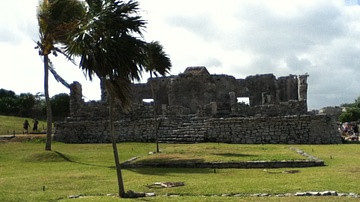
Building 25, Tulum, Mexico
The structure known as Building 25 was possibly part of the administrative complex of the city of Tulum. The city thrived as a trading center between the 11th-16th centuries CE.
