
Search
Remove Ads
Advertisement
Search Results

Article
Early Muslim Conquests (622-656 CE)
Islam arose as a religious and socio-political force in Arabia in the 7th century CE (610 CE onwards). The Islamic Prophet Muhammad (l. 570-632 CE), despite facing resistance and persecution, amassed a huge following...
Definition
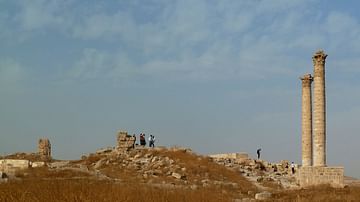
Edessa
Edessa (modern Urfa), located today in south-east Turkey but once part of upper Mesopotamia on the frontier of the Syrian desert, was an important city throughout antiquity and the Middle Ages. A city within the Seleucid Empire, then...

Definition
War of the Second Coalition
The War of the Second Coalition (1798-1802), part of the broader French Revolutionary Wars, was the second attempt by an alliance of major European powers to defeat Revolutionary France. The Second Coalition, which included...

Definition
Ancient China
Ancient China produced what has become the oldest extant culture in the world. The name 'China' comes from the Sanskrit Cina (derived from the name of the Chinese Qin Dynasty, pronounced 'Chin') which was translated as 'Cin' by...

Definition
Gezer
Gezer is an ancient city and archaeological site located in central Israel where the central mountains meet the northern Shephelah, about 10 km southeast of the city of Ramleh. According to the Hebrew Bible, Gezer was one of the great...

Article
Ten Ancient Rome Facts You Need to Know
Ancient Roman culture affected vast numbers of people across the known world of its time, beginning with the rise of the Roman Republic (509-27 BCE) and throughout the duration of the Roman Empire (27 BCE -...

Article
Ten Ancient Persia Facts You Need to Know
Ancient Persian culture exerted a powerful influence throughout the Near East, and beyond, for over a thousand years between c. 550 BCE - 651 CE and many aspects of their culture continued to influence others...

Definition
Heraclius
Heraclius (Herakleios) was emperor of the Byzantine Empire from 610 to 641 CE. He crushed the Persian empire and returned the looted True Cross to Jerusalem, but the second half of his reign was beset by intrigues and ecclesiastical...

Definition
Uthman
Uthman ibn Affan (l. 576/583-656 CE) was an early convert to Islam, a close friend and son-in-law of Prophet Muhammad (l. 570-632 CE), and the third caliph (r. 644-656 CE) of the Rashidun Caliphate (632-661 CE). His charitable acts and...

Definition
Constantine IV
Constantine IV ruled as emperor of the Byzantine empire from 668 to 685 CE. His reign is best remembered today for the five-year Arab siege of Constantinople from 674 CE, which the Byzantines resisted thanks to their strong fortifications...
