
Search
Remove Ads
Advertisement
Search Results

Definition
Grossmunster
Grossmünster (“large cathedral” in German) is a Romanesque ex-cathedral situated in the heart of Zürich, Switzerland, which was built over the course of the 11th and 13th centuries CE. According to legend, the Holy Roman Emperor...

Definition
Domitian
Domitian was Roman Emperor from 81 to 96 CE and his reign, although one of relative peace and stability, became engulfed in both fear and paranoia. His death at the hands of those who were closest to him brought an end to the short...

Definition
Nefertiti
Nefertiti (c. 1370 - c. 1336 BCE) was the wife of the pharaoh Akhenaten of the 18th Dynasty of Egypt. Her name means, `the beautiful one has come' and, because of the world-famous bust created by the sculptor Thutmose (discovered in...

Definition
Pliny the Elder
Aside from the usual contributions of its noble politicians and military commanders, the story of a nation also records the invaluable literary influences of its poets, dramatists, and historians. The long history of the Roman...

Definition
Trajan
Trajan, or Marcus Ulpius Traianus, was Roman emperor from 98 to 117 CE. Known as a benevolent ruler, his reign was noted for public projects which benefitted the populace such as improving the dilapidated road system, constructing aqueducts...

Definition
Carolingian Dynasty
The Carolingian Dynasty (751-887) was a family of Frankish nobles who ruled Francia and its successor kingdoms in Western and Central Europe during the Early Middle Ages. The dynasty expanded from Francia as far as modern Italy...
Definition
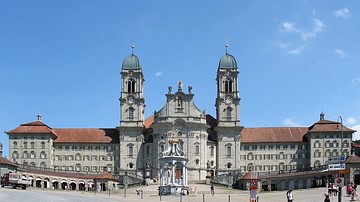
Einsiedeln Abbey
Einsiedeln Abbey and Monastery (German: Kloster Einsiedeln), located some 31 km (19 mi) southeast of Zürich at the foot of a hill in the town of Einsiedeln in Canton Schwyz, Switzerland, is the most important site of Roman Catholic...

Definition
Homo Heidelbergensis
Homo heidelbergensis is an extinct species of human that is identified in both Africa and western Eurasia from roughly 700,000 years ago onwards until around 200,000 years ago – fitting snugly within the Middle Pleistocene...

Definition
Hallstatt Culture
The Hallstatt culture is named after the site of that name in Austria and it flourished in central Europe from the 8th to 6th century BCE. The full period of its presence extends from c. 1200 to c. 450 BCE - from the Late Bronze...

Definition
La Tène Culture
The La Tène culture (c. 450 - c. 50 BCE) is named after the site of that name on the northern shores of Lake Neuchâtel in Switzerland. It replaced the earlier Hallstatt culture (c. 1200 - c. 450 BCE) as the dominant culture of...
