
Search
Remove Ads
Advertisement
Search Results
Image
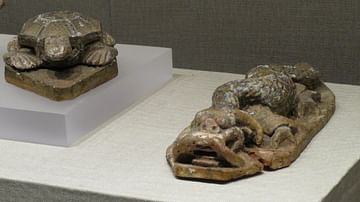
Cardinal Turtle & Dragon from Xanadu
A black turtle and azure dragon representing the cardinal directions of north and east respectively. From Xanadu (Shangdu), the summer capital of the Yuan Dynasty (1271-1368 CE). (Archaeological Museum of Inner...

Image
Stone Turtle, Karakorum
A stone turtle at Karakorum, Mongolia, from the khan's palace there. The city was made capital of the Mongol Empire in 1235 CE by Ogedei Khan (r. 1229-1242 CE).

Image
Genghis Khan Equestrian Statue
This 40 meter (131 foot) tall equestrian statue of Genghis Khan (r. 1206-1227 CE) was erected in 2008 CE. The statue stands on top of the Genghis Khan Statue Complex, on the bank of the Tuul River near Ulaanbaatar...
Image
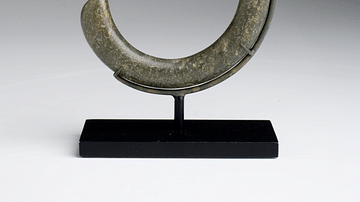
Hongshan Jade Dragon
The jade dragon from Hongshan, Inner Mongolia, China. Dating to between 4500 and 3000 BCE, it is the earliest known depiction of a dragon. National Museum of China, Beijing. Image by David Owsley Museum, used with permission...
Image
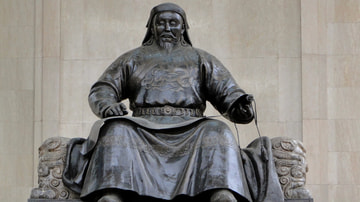
Kublai Khan Statue
A modern statue of the Mongol ruler Kublai Khan (l. 1215-1294 CE). Sukhbaatar Square, Ulaanbaatar, Mongolia.

Image
Mongolian Saddle
A Mongolian saddle from China dating to between c. 1271–1368 CE, when China was ruled by the Yuan Dynasty. From the Inner Mongolia Museum in Hohhot, China.

Video
Why Were the Mongols So Successful?
Why were the Mongols so successful? Mongol military history and battle tactics. Support new videos and join the horde on Patreon! :D I draw, edit, research, narrate and write every episode...all help is much appreciated...
Image
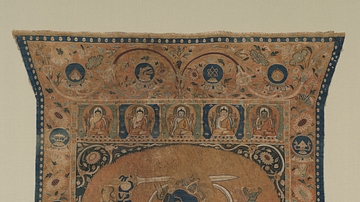
Achala, King of the Wrathful Ones
Achala, King of the Wrathful Ones; Inner Mongolia, Tangut Xia, Khara Khoto (1038–1227 CE); early 13th century CE; silk and pearls; overall: 40 1/4x 29 1/8 in. (102.3 x 74 cm); The Cleveland Museum of Art; purchase...

Image
A Glass of Kumis
A glass of kumis (airagh), the fermented mare's milk drink that has been popular in Mongolia and elsewhere for centuries.

Book Review
On the Way to the "(Un)Known"?: The Ottoman Empire in Travelogues (c. 1450-1900)
Some people like to believe that the Ottoman Empire was Europe’s ultimate “other.” Several European nations, not least the Serbs and the Hungarians, consider themselves those...
